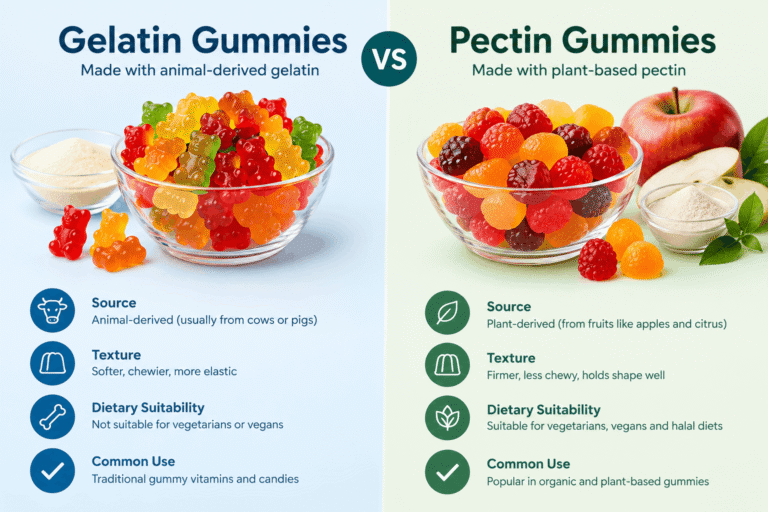
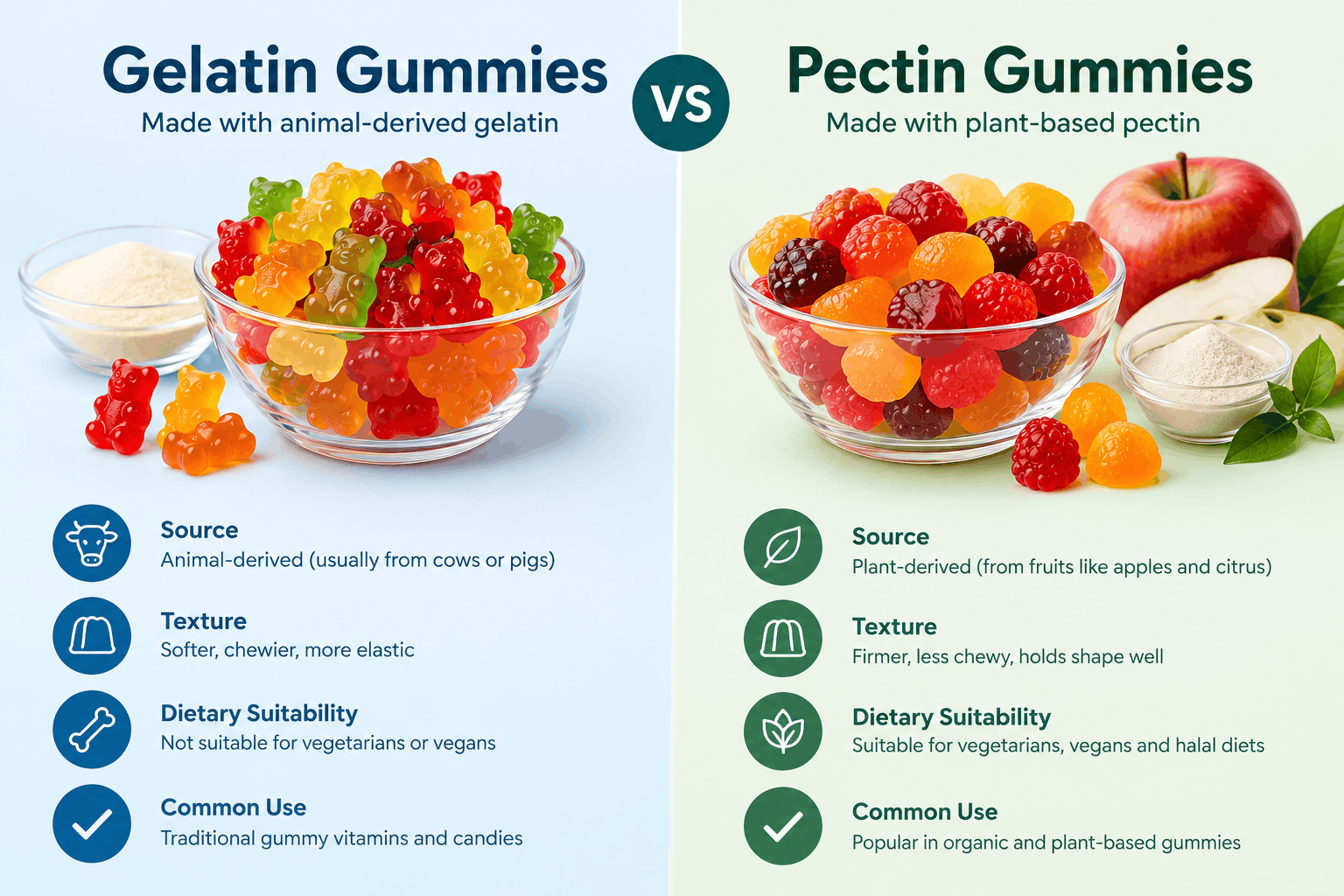
Gelatin vs pectin gummies comes down to source, texture, and heat tolerance. Gelatin is animal-based, gives the classic elastic chew, and melts at about 35 to 37 °C, close to body temperature. Pectin is plant-based, sets firmer and tolerates heat, but it needs tighter process control.
This guide is for B2B brand owners, product developers, and sourcing teams choosing a base for a private label gummy. You will get a side-by-side comparison, the process window pectin needs, a decision table, and a sample test scorecard. We wrote it from the factory side at Youdi Nutrition, which makes pectin-based, gelatin-free gummies.
Gelatin vs Pectin Gummies: What is the Difference?
Gelatin gummies use a protein from animal collagen as the gelling agent. Pectin gummies use a plant fibre extracted from fruit such as citrus peel or apples. Gelatin gives an elastic chew and melts near body temperature. Pectin gives a firmer, shorter bite and does not melt at body temperature.
| Factor | Gelatin gummies | Pectin gummies |
| Source | Animal collagen, typically pork or beef | Plant fibre from citrus peel or apples |
| Texture | Chewy and elastic | Firmer, shorter bite, less elasticity |
| Melting | About 35 to 37 °C | Does not melt at body temperature |
| Heat in shipping | Can soften, stick or deform | Holds up better in warm conditions, but not immune |
| How it gels | On cooling | Through pH, temperature, and solids, and it needs acid |
| Failed batch | Can be re-melted | Usually scrapped |
| Dietary fit | Not vegan; halal depends on the source | Vegan; no animal gelling agent to source |
| Moisture risk | Less sensitive | Needs tight water activity control; can dry out |
Sources: Sourcify for origin and moisture, Chemtrade Asia for melting behaviour, Food & Beverage Insider for failed batches, and Knauer for texture.
Which base gives the better texture?
Gelatin gives the classic elastic chew, and pectin gives a firmer, shorter bite. Neither wins on its own. Gelita, a gelatin producer, reports that pectin gummies were significantly harder and less elastic in its tested formulations. A Cargill consumer study found that participants favoured a softer texture made from pectin or tapioca.
Cargill’s study also notes that the top-selling gummies in the US are gelatin-based. Gelatin itself varies: a recent study of gelatin sources found hardness, gumminess, cohesiveness and springiness comparable across sources, while adhesiveness and stringiness changed with the source. Texture is a preference, not a verdict. Test both bases with your target customers before you choose.
Who this is not for: if your market expects the classic bounce of a gummy bear, a standard pectin formula may feel different. Ask for a softer pectin formula or a sample of both.
Which base holds up better in heat and shipping?
Pectin usually holds up better in heat, because gelatin gummies melt near body temperature and can stick together in warm shipping. A Knauer analytical study found that heat changed gelatin gummies but showed no significant difference in pectin gummies. Pectin still dries out if moisture shifts, so both bases need stability testing.
Nutritional Outlook makes the same point for hot countries and supermarkets without air conditioning. A heat advantage does not remove the need for sealed packaging and a warm-room test.
• Gelatin risk: pieces soften, deform and fuse in transit.
• Pectin risk: pieces harden, crack or dry out if water activity drifts.
• Both: run a stability test on the finished, packed product before launch.
Which base is harder to manufacture?
Pectin is harder to make. It sets only inside a narrow window: depositing near 180 °F, a final pH of 3.4 to 3.6 and 78 to 82 Brix, according to Food & Beverage Insider. A failed gelatin batch can be re-melted. A failed pectin batch is usually scrapped.
Flavours, colours and actives shift the pH, so factories use buffering salts to hold it inside the window. Gelatin is also easier on the line: Roquette technical guide notes that factories add gelatin as a solution after cooking, because long heat can degrade it, while pectin tolerates heat. Factory capability for gelatin is more widespread, per Sourcify.
| Pectin control point | Target | Source |
| Depositing temperature | About 180 °F | Food & Beverage Insider |
| Final pH | 3.4 to 3.6 | Food & Beverage Insider |
| Solids | 78 to 82 Brix | Food & Beverage Insider |
| Rework of a failed batch | Not possible | Agro FOOD Industry Hi Tech |
How do the gelatin and pectin processes differ step by step?
Both processes cook a syrup and deposit it into molds, but they differ in when the gelling agent goes in and what triggers the set. Gelatin is added as a solution after cooking and sets as it cools. Pectin is cooked in, then acid and buffer salts bring the pH into its gelling window before depositing.
| Step | Gelatin gummies | Pectin gummies |
| 1. Prepare the gelling agent | Hydrate gelatin and dissolve it into a solution | Disperse pectin so it hydrates fully and does not clump |
| 2. Cook the syrup | Cook sugars or sweeteners, without gelatin in the pot | Cook pectin with the syrup to the target solids |
| 3. Add the gelling trigger | Add the gelatin solution after cooking | Add acid and buffer salts to reach the target pH |
| 4. Add actives, flavour and colour | Add late, at the lowest workable temperature | Add late and recheck the pH, because they shift it |
| 5. Deposit | Deposit into moulds | Deposit near 180 °F |
| 6. Set | Sets as it cools | Sets through the pH, solids and temperature window, then dries |
Sources: Roquette on adding gelatin after cooking, and Food & Beverage Insider on the pectin window. Step wording is a summary, and each factory adjusts the order for its line.
What happens to vitamins and activities in each base?
Heat, light, and pH can degrade vitamins in either base, but pectin adds a pH limit: the batch must end near pH 3.4 to 3.6, so acidic or alkaline actives can push it out of the window. Vitamin C is itself an acid, and adding it can make a base set too firmly or at the wrong time, according to formulators quoted by SupplySide.
• Acid-sensitive actives: check that they survive a pH of 3.4 to 3.6 in a pectin base.
• Heat-sensitive actives: add them late in either base.
• Dose accuracy: ask whether the factory uses overage and request a finished-product COA.
Neither base protects a vitamin on its own. Ask for stability data on your exact formula, not on the base.
Which base suits vegan, vegetarian, and halal gummies?
Pectin suits vegan and halal gummies because it contains no animal ingredients. Gelatin is typically pork or beef, so it fails vegan claims and needs a halal source check. That is why brands searching for gelatin-free gummies private label or a vegan gummy bear manufacturer end up with pectin.
| Claim | What it needs | What to verify |
| Vegan | No animal ingredient anywhere in the formula | Colours, flavours, coating and vitamin sources, such as the origin of vitamin D3 |
| Halal | Halal-suitable ingredients and a certificate that covers the format | Certifier, certificate scope and expiry date |
| Sugar-free | A sweetener swap | Texture and set, because sugar adds bulk and structure |
Gummies from Youdi Nutrition are pectin-based, gelatin-free and vegan-friendly, with sugar-free options sweetened with stevia and monk fruit. Our halal certificate comes from the Halal Development Institute of Indonesia. See our assorted gummy bears for the classic shape in a pectin base.
Can you combine gelatin and pectin in one gummy?
Yes, hybrid gummies exist, but they lose the vegan and gelatin-free claims. A blend can soften the chew and raise the melting point compared with gelatin alone. Confectionery News reports a layered candy that uses both gelatin and pectin. Gelatin and pectin respond differently to temperature and pH, so the ratio and timing need careful control.
Choose a hybrid only if you sell to a market with no vegan or halal requirement and you want a softer, more heat-tolerant chew. If you need a plant-based or gelatin-free label, use a full pectin base.
How do the bases change shelf life and packaging?
Both bases need moisture control, but they fail in different ways. Gelatin gummies soften and fuse in heat. Pectin gummies depend on tight water activity control and can harden, crack, or dry out if moisture shifts, according to Sourcify. Packaging must match the base.
• Seal the pack: use jars, pouches, or bottles that close fully.
• Test desiccants: they can help in some packs but need evaluation, and they can over-dry a pectin gummy.
• Run a stability test: test the finished, packed gummy across the shelf life you plan to claim.
• Plan for heat: if you ship to warm regions, run a heat test on the packed product.
Youdi Nutrition packs gummies in jars, pouches, and bottles with private label printing, and we confirm the pack against the formula. See our products page for every format.
How do you choose a pectin gummies manufacturer?
Choose a pectin gummies manufacturer by its process control, not its brochure. Ask for the pH, solids, and temperature window it holds, its water activity target, finished-product COAs and stability data, and the certificates that cover the facility. A factory that cannot answer within a few days is a risk for your first batch.
1. Which pH, solids, and deposition temperature window do you hold for pectin?
2. What is your water activity target, and how do you check it?
3. How do you buffer the pH when flavours, colours, and activities change it?
4. Can I see a finished-product COA and stability data?
5. What is your scrap or reject rate on pectin batches?
6. Which certificates cover the facility, and what are their scope and expiry dates?
7. What are the MOQ routes and the lead time?
8. Who owns the formula, and can I move it to another factory?
Youdi Nutrition runs in-process quality control and batch traceability, and third-party COAs are available for every batch. Our certificates include NSF/ANSI 455-2 GMP, HACCP, and FSSC 22000. See our quality page. Our pectin range includes fruit gummy bites, cube gummies, and filled gummies.
How do you test both bases before you commit?
For a fair gelatin vs pectin gummies test, request two samples of the same formula, one pectin and one gelatin, and test them side by side for texture, heat tolerance and taste. Score both on the same sheet. At Youdi Nutrition, free sample production is step 3 of our OEM process, before you confirm formula and packaging.
1. Brief the factory: same dose, same flavour, same shape for both bases.
2. Run a texture panel: ask five people who match your target customer.
3. Run a heat test: leave a sealed sample in a warm room for a week.
4. Check the COA: compare moisture and active content with your target.
5. Score and decide: fill in the sheet below.
Which gummy base should your brand choose?
In the gelatin vs pectin gummies decision, choose pectin for vegan or halal markets and for hot climates. Choose gelatin when the classic elastic chew is your selling point, and you want the simplest production. The table matches common situations to a base.
| Your situation | Better base | Why |
| Vegan or halal market | Pectin | No animal gelling agent to source or certify |
| Hot climate or long shipping | Pectin | Holds up better in heat than gelatin |
| The classic elastic chew is the selling point | Gelatin | Gives the elastic, melt-in-mouth chew |
| You prefer a softer, airier bite | Pectin (soft formula) | Cargill’s study found consumers favoured softer pectin or tapioca textures |
| Simplest, most forgiving production | Gelatin | A failed batch can be re-melted, and more factories run it |
A small first order lets you test your choice. At Youdi Nutrition, a shared batch starts at 100 units per brand and runs once combined orders reach 500 units. A market-test order starts at 200 units, and full custom production starts at 500 units. See the shared MOQ program and our one-stop manufacturing service.
Frequently asked questions
Are pectin gummies vegan?
Pectin is plant-based, so the gelling agent is vegan. The whole formula must also be free of animal ingredients, including colours, flavours, coatings, and some vitamin sources. Ask your manufacturer for an ingredient-level statement.
Do pectin gummies melt?
Pectin gummies do not melt at body temperature, and an analytical study found heat did not significantly change them. They can still dry out or harden if moisture shifts, so store them sealed and cool.
Can I switch from gelatin to pectin?
Yes, but not as a one-for-one swap. Pectin needs acid, solids, and temperature in a narrow window, so the factory reformulates and tests samples. Expect a firmer texture and a new sample round.
Are gelatin-free gummies halal?
Gelatin-free gummies remove the main halal problem, but halal also covers flavours, colours, processing aids, and a valid certificate. Check the certifier and the scope. Youdi Nutrition’s halal certificate comes from the Halal Development Institute of Indonesia.
Which is cheaper, gelatin or pectin gummies?
Cost depends on formula, yield, and quantity, so request written quotes for both bases on the same specification.
What is the minimum order for pectin gummies at Youdi Nutrition?
A shared batch starts at 100 units per brand and runs once combined orders reach 500 units. A market-test order starts at 200 units. A full custom run starts at 500 units. Request a written quote for exact pricing.
Ready to test a pectin gummy sample?
Choosing between gelatin vs pectin gummies is easier with samples in hand. Tell Youdi Nutrition your target market, flavour, and quantity, and our team will recommend a base, confirm the MOQ route, and send a free sample plan. Browse our product formats, read the FAQ, or contact our team for a free formula consultation.
Limits of this guide: process windows and temperatures differ by factory and formula, and several figures here come from trade and supplier sources. It is not legal advice. Confirm halal and vegan claims with your certifier.