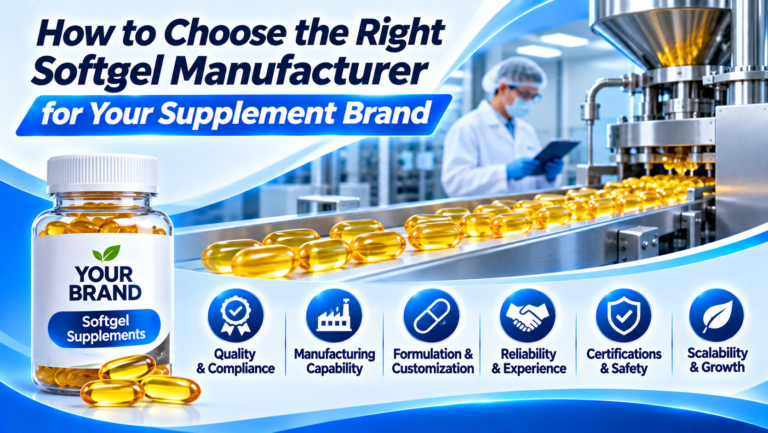
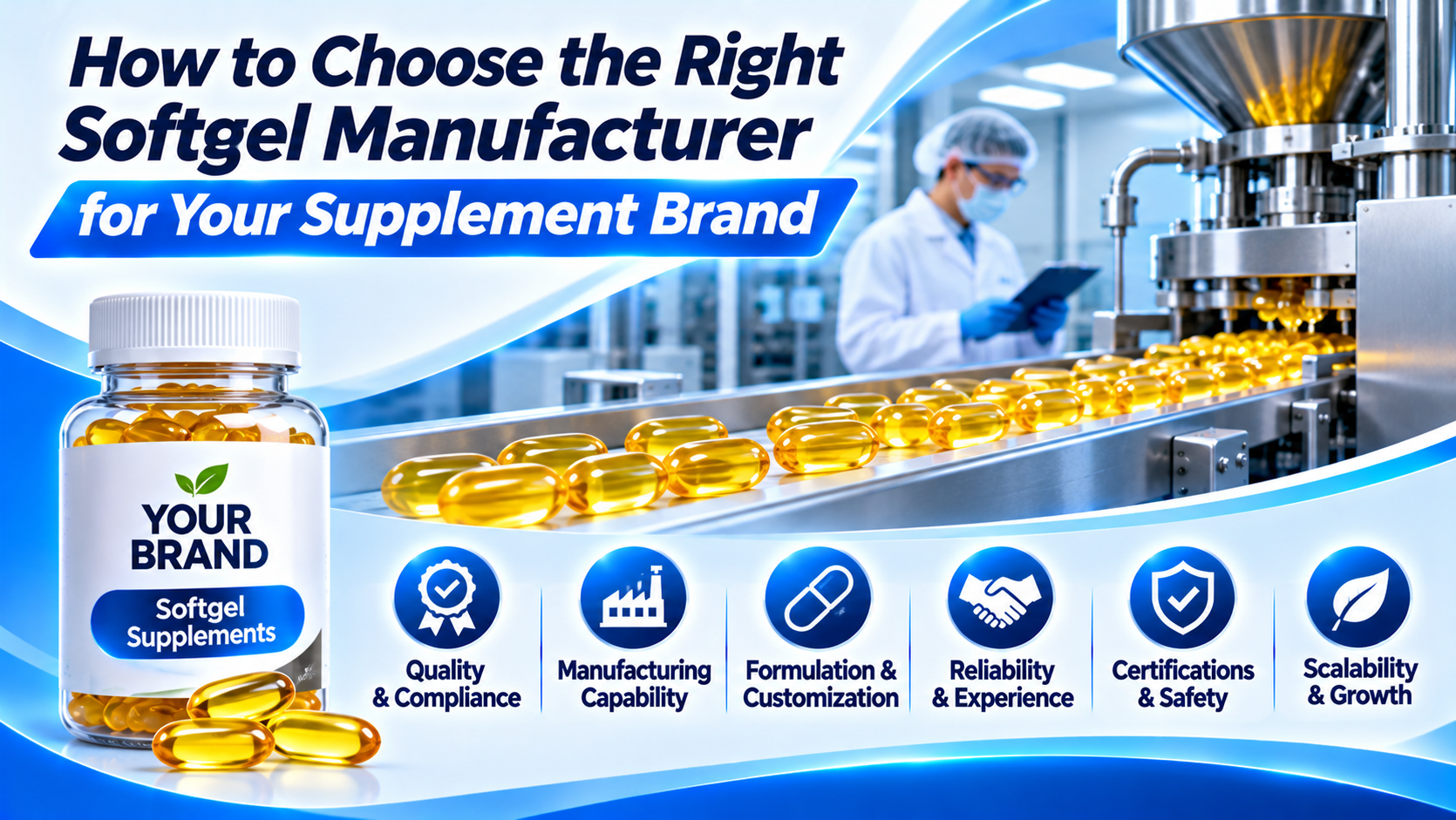
The right softgel manufacturer is one that can prove its compliance, formulate for your specific ingredients, test what it makes, and support your brand as order volumes grow. Price matters, but it should come last in the evaluation, because a cheap batch that fails stability testing or draws a regulatory problem costs far more than a higher quote.
This guide walks through the criteria that separate a dependable partner from a risky one, with practical questions you can use when comparing softgel capsule manufacturers.
What Makes Softgels Different From Other Supplement Formats
Softgels are a distinct format with their own manufacturing demands, so a manufacturer that does tablets or hard capsules well isn’t automatically good at softgels.
A softgel is a one-piece capsule with a flexible shell that surrounds a liquid or semi-solid fill. Softgel manufacturing typically uses a rotary die process: two ribbons of shell material are formed, the fill is injected between them, and the capsules are sealed and cut in a single step. The capsules are then dried, inspected, and polished.
This matters for buyers because softgels suit certain ingredients far better than others. They work well for oil-based and lipophilic ingredients such as fish oil, vitamin D, vitamin E, and CoQ10, and for formulas where a smooth, easy-to-swallow format helps sales. They are a poor fit for ingredients that are water-heavy or that react with the shell. Knowing this up front helps you judge whether a manufacturer is giving you honest guidance or simply saying yes to everything.
Check Compliance and Certifications First
Confirm compliance before you discuss formulas, samples, or pricing. If a facility can’t document it, nothing else on this list matters.
cGMP under 21 CFR Part 111
In the United States, dietary supplements must be manufactured under current Good Manufacturing Practice requirements set out in 21 CFR Part 111. These rules cover facility design, equipment, written procedures, component identity testing, batch records, and finished product specifications. FDA also expects manufacturing facilities to be registered.
One point brands often miss: outsourcing production does not outsource responsibility. As the brand owner, you remain accountable for the product you sell, so you need to see how your manufacturer meets these requirements, not just hear that it does. Ask for recent audit results or certificates and find out how the facility handles deviations and corrective actions.
Third-party certifications
Independent certifications add a layer of verification beyond a manufacturer’s own claims. Depending on your market, relevant programs include NSF’s GMP registration for dietary supplements (NSF/ANSI 455-2) and USP’s Verified Mark program. Food safety systems such as HACCP and FSSC 22000 add further assurance, and Halal certification matters if you sell into markets that require it. A manufacturer should be able to show you its certifications and quality standards in documents, not just in marketing copy. A manufacturer that holds none and offers no other documentation should prompt more questions.
Evaluate Formulation and Technical Capability
A strong softgel manufacturer helps you design a formula that can actually be encapsulated, stay stable, and deliver what the label says.
Shell options: gelatin vs. plant-based
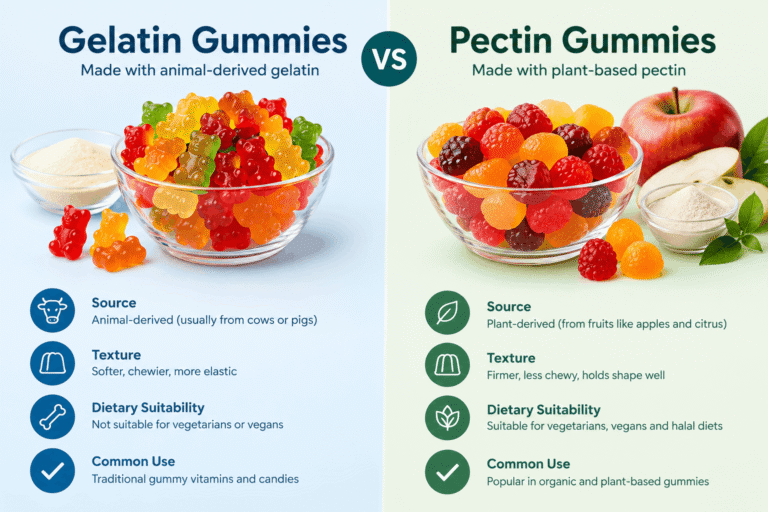
Traditional softgel shells use gelatin. Plant-based alternatives, commonly made with starches or carrageenan, serve vegetarian and vegan positioning. They are not interchangeable: they can differ in how they handle heat, moisture, and certain fills. If your brand identity depends on being vegan, ask whether the manufacturer runs plant-based shells regularly or only as a rare special request, and confirm it in writing for your specific formula.
Fill compatibility and stability
Oils oxidize, actives can settle or separate, and shells can soften or leak if the fill is wrong. A capable manufacturer should discuss carrier oils, antioxidants, suspension of solid actives, and shelf-life expectations rather than just quoting a price. Ask what stability testing they perform or support, and how they determine expiration dating. A manufacturer that asks detailed questions about your formula is usually a good sign.
Ask How Quality Control and Testing Work
Good quality control means testing at multiple stages and being able to show the results.
Look for these basics:
- Identity testing of incoming raw materials, as required by cGMP
- In-process checks on fill weight, seal integrity, and shell condition
- Finished product testing against specifications, such as potency, contaminants, and microbial limits
- A Certificate of Analysis (COA) for each batch, ideally from an independent laboratory
- Retained samples and traceable batch records from raw material to finished goods
- A clear process for handling out-of-specification results
Also ask whether testing is done in-house, by an outside accredited laboratory, or both. Neither is automatically better, but the manufacturer should be able to explain who tests what and how results reach you. Seeing the production and quality control process for yourself, whether through documentation, photos, or a video walkthrough, tells you far more than a sales deck does.
Understand Minimum Order Quantities, Pricing, and Lead Times
For emerging brands, minimum order quantities (MOQs) often decide which manufacturers are realistic. MOQs differ widely between facilities and depend on the formula, so ask directly instead of assuming.
Some manufacturers have built programs around this problem. A shared MOQ program, for example, lets several brands share one production batch so each can start with a much smaller quantity than a full custom run requires. It’s worth asking any manufacturer whether a similar route exists, and how it affects formula options and packaging.
Look at Scalability and Supply Chain Transparency
Pick a manufacturer you can grow with, since switching partners mid-growth means reformulation, new testing, and possible supply gaps.
Ask whether they can handle larger runs when demand rises, and how they source key ingredients such as fish oil. Ask about supplier qualification and whether raw materials can be traced to their origin. If you plan to expand your product line, find out whether the manufacturer also covers other supplement formats, such as gummies, powders, or liquid drops, so you can keep a single partner as your range grows.
Assess Communication and Support for New Brands
Responsiveness during the quoting stage usually predicts responsiveness once production starts. Notice whether your questions get specific answers, whether regulatory topics are handled knowledgeably, and whether the team explains trade-offs instead of pushing one option.
New brands especially benefit from partners who can guide label compliance basics. Under DSHEA, supplements can carry structure/function claims, but those claims must be truthful and not misleading, and the required disclaimer and notification obligations apply. A manufacturer can point you in the right direction, but final label and claim responsibility remains yours, so consider a regulatory professional for your specific claims.
FAQs
How do I find a reliable softgel manufacturer?
Start with documented compliance: FDA registration, cGMP practices under 21 CFR Part 111, and any third-party certifications. Then compare technical capability, testing processes, and communication, and request samples before committing.
What is the difference between softgel and hard capsule manufacturing?
Softgel manufacturing encapsulates liquid or semi-solid fills inside a sealed, flexible shell in one process, while hard capsules are two pieces typically filled with powders or pellets. Softgels are usually better for oils and lipophilic ingredients.
Do softgel capsule manufacturers offer vegan options?
Many offer plant-based shells, but availability varies. Confirm that the manufacturer runs them routinely and ask how they perform with your specific fill.
Can a small brand work with a softgel manufacturer?
Yes, but MOQs differ between facilities. Ask about minimums early, since they often determine whether a manufacturer fits an emerging brand’s budget. You can also browse our frequently asked questions for typical MOQ routes and sample options.