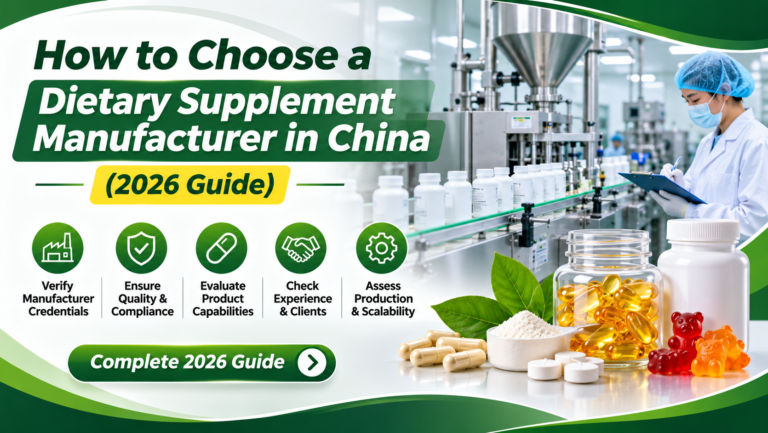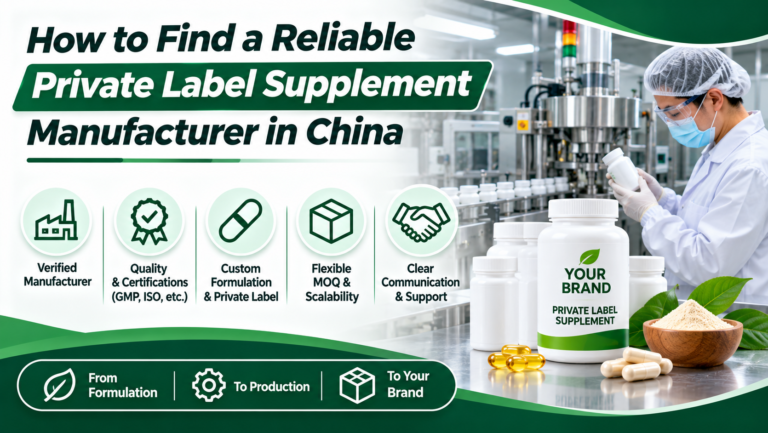
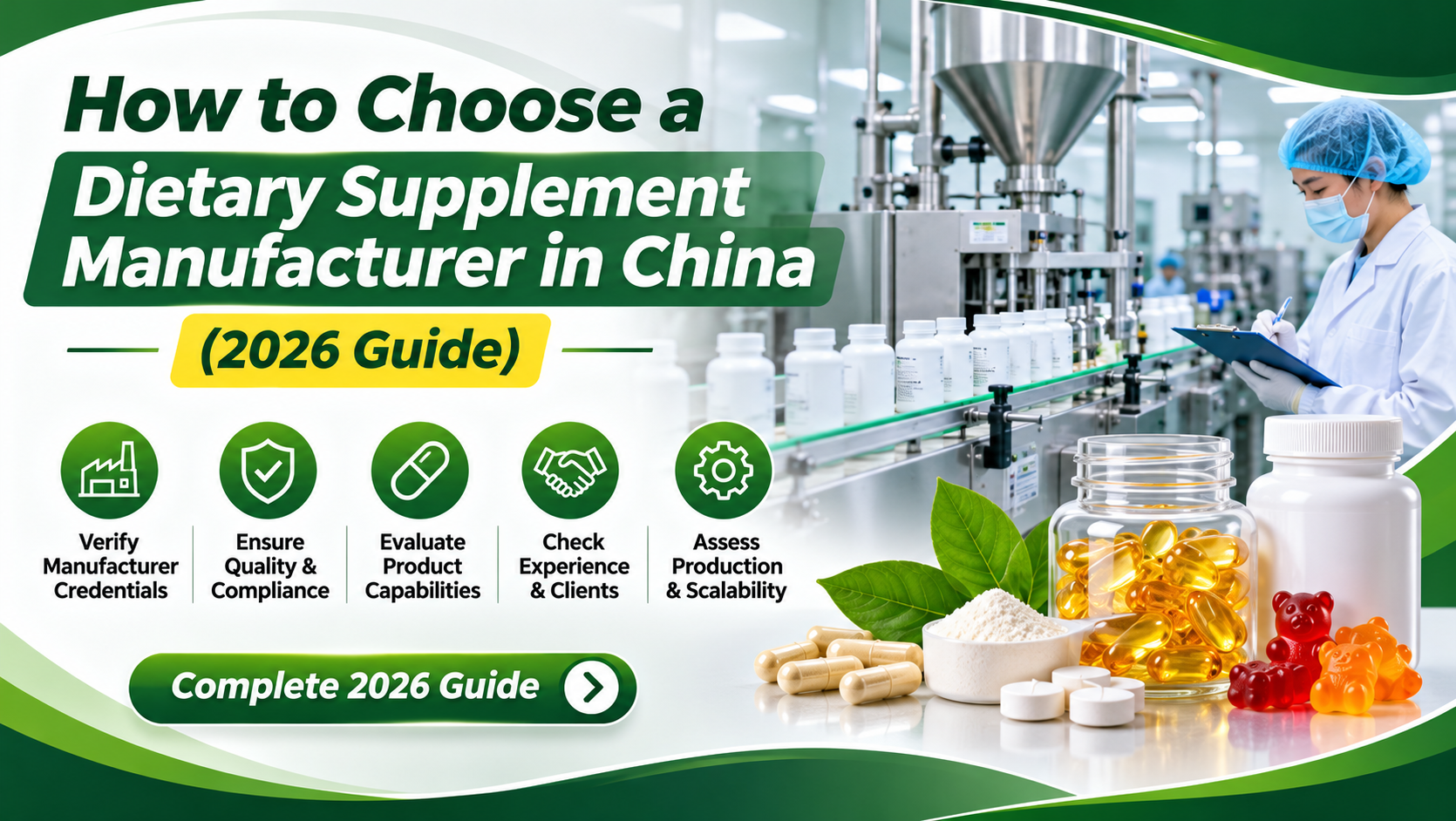
Choosing a dietary supplement manufacturer in China is one of the most important decisions you will make when launching a brand. The right partner gives you consistent quality, fair pricing, and a smooth path from first sample to finished goods. The wrong one can cost you money, time, and your reputation.
China is home to thousands of supplement factories, and the range in quality is huge. Some operate cleanroom facilities with international certifications. Others are little more than trading companies reselling someone else’s product. This guide shows you exactly what to check, which questions to ask, and which red flags to avoid, so you can choose with confidence.
Why Brands Source Supplements From China
Brands of every size work with Chinese manufacturers for a few practical reasons:
- Format variety: One factory can often produce gummies, capsules, softgels, powders, liquid drops, and jelly sticks, so you can build a full line with one partner.
- Competitive pricing: Lower production costs let new brands protect their margins.
- Flexible capacity: Many factories now offer smaller runs, which makes it possible to test a product before committing to a large order.
- Strong gummy and softgel expertise: Gummies in particular have become a core specialty for many Chinese OEM/ODM factories.
Sourcing from China works well when you choose the right factory. The rest of this guide helps you do that.
OEM vs ODM: Know What You Need First
Before you contact any factory, decide which model fits your project.
- OEM (Original Equipment Manufacturing): You provide the formula and the factory produces it to your specification.
- ODM (Original Design Manufacturing): The factory helps with formulation, flavour development and sometimes packaging design, then produces the product under your brand (private label).
If you are a new brand without an in-house formulator, an ODM partner is usually the better choice. Look for a manufacturer that handles formulation, flavour development, production, and packaging under one roof, so you are not managing several suppliers.
7 Things to Check Before You Choose
1. Certifications That Matter
Certifications are your first filter. For a supplement manufacturer, look for:
- GMP certification: Good Manufacturing Practice shows the factory follows documented quality systems. Third-party GMP certification, such as NSF/ANSI 455-2 for dietary supplements, carries more weight than a self-declared claim.
- HACCP: A food safety system that identifies and controls hazards during production.
- FSSC 22000: A globally recognised food safety management certification.
- FDA food facility registration: Required for facilities that manufacture food or supplements for the US market. Note that registration is not the same as FDA approval, since the FDA does not approve dietary supplements before they are sold.
- Halal or other certifications: Important if you plan to sell in Muslim-majority markets or want broader global reach.
2. Real Manufacturing Capability (Factory vs Trading Company)
Many suppliers on B2B platforms are trading companies. They are not always a problem, but you should know who actually makes your product.
Ask for:
- A live video tour of the production floor
- Photos or videos of mixing, depositing, filling, and packaging lines
- The factory’s business licence and registered address
- Confirmation of where your product will be physically made
A genuine manufacturer will show you cleanroom areas, equipment, and quality control stations. For gummies, ask specifically about their depositing line and how they control texture and potency batch to batch.
3. Minimum Order Quantity (MOQ) and Launch Flexibility
High MOQs are one of the biggest barriers for new brands. Many factories require thousands of units per SKU, which forces you to invest heavily before you know whether the product will sell.
Look for a manufacturer that offers staged routes, for example:
- Samples to check taste, texture, and look
- Market-test orders from around 200 units
- Shared production runs from about 100 units per brand, where several brands share one batch
- Full custom production from around 500 units, with custom formula, flavour, dosage and printed packaging
Flexible MOQ lets you validate demand first and scale only when the product sells. If you are searching for a low MOQ supplement manufacturer, this is the single most useful feature to compare.
4. Testing and Third-Party COAs
A Certificate of Analysis (COA) proves what is actually in your product. Always ask:
- Are third-party COAs available for every batch?
- Do they cover active ingredient content, heavy metals, microbiology, and other key parameters?
- Is there full traceability from raw materials to finished goods?
Batch traceability means that if an issue appears, the factory can trace it back to the exact raw material lot. This is a strong sign of a serious quality system.
5. Formulation and Product Expertise
Not every factory is good at every format. Ask what they specialise in and request examples.
For gummies, check whether they can offer:
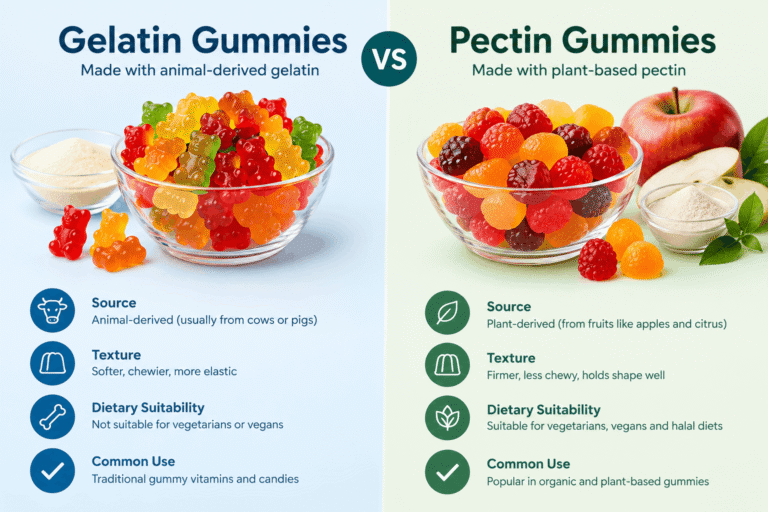
- Pectin-based, gelatin-free and vegan formulas
- Sugar-free options using sweeteners such as stevia and monk fruit
- Stable high-dose actives like vitamins, minerals, botanicals, magnesium, or L-theanine
- Consistent potency and texture across batches
Always request a sample before you order. Taste and texture decide whether customers reorder, and a sample is the cheapest way to test both.
Regulatory Knowledge for Your Target Market
Your product must comply with the rules of the country where you sell it. In the US, supplements are regulated under DSHEA and manufacturing must follow cGMP requirements (21 CFR Part 111). In the EU, UK, Australia, and other markets, ingredient limits, permitted claims, and labelling rules differ.
A good manufacturer should:
- Understand which ingredients are allowed in your target market
- Help you avoid restricted ingredients and non-compliant dosages
- Support label content with the correct supplement facts and ingredient declarations
Remember that you, as the brand owner, are ultimately responsible for compliance and claims. A manufacturer can guide you, but always confirm the final label and claims with a regulatory professional for your market.
7. Communication, Packaging and Shipping Support
Communication problems cause more failed projects than factory defects. Check how quickly and clearly the team responds, whether they communicate in fluent English, and whether they use a clear process with timelines.
Also confirm:
- Custom printed packaging and private label support
- Packaging lead times
- Global shipping experience and who handles export documentation
- Clear quotation covering formulation, production, packaging and freight
Red Flags to Avoid
Walk away or investigate further if you see any of these:
- No certificates, or certificates that cannot be verified
- Refusal to do a video call or factory tour
- Prices far below the market, which often signals cheap or substituted ingredients
- Vague answers about where the product is made
- No sample option
- No COAs or testing records
- Pressure to pay the full amount upfront without a written agreement
- Claims of curing or treating diseases, which are not allowed for supplements and show poor regulatory awareness
Frequently Asked Questions
Is it safe to buy dietary supplements from a manufacturer in China?
Yes, if you choose a verified manufacturer. Look for GMP and food safety certifications, third-party COAs, FDA facility registration (for the US market) and a transparent factory tour. Always request samples and test results before placing a large order.
What is the typical MOQ for a supplement manufacturer in China?
It varies widely. Traditional factories often require thousands of units, while flexible manufacturers offer shared batches from around 100 units per brand, test orders from about 200 units, and full custom runs from about 500 units.
What is the difference between a supplement manufacturer and a trading company?
A manufacturer owns the production facility and equipment. A trading company sources products from other factories. Ask for a business licence, factory video, and production photos to confirm who actually makes your product.
How long does it take to manufacture dietary supplements in China?
Timelines depend on the format, formulation complexity, and packaging. Sampling usually comes first, followed by production and shipping. Ask your manufacturer for a written timeline for each stage when you request a quote.
Do Chinese manufacturers offer private label supplements?
Yes. Many offer private label and custom packaging, plus formulation and flavour development, so your product launches under your own brand name.
Can I get a sample before ordering?
Yes, and you should. A sample lets you check taste, texture, and appearance before committing to production.