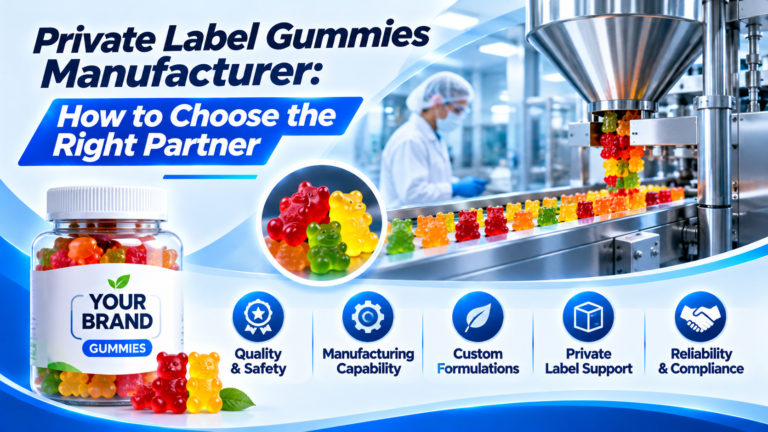
How are gummy vitamins made? Factories cook a pectin or gelatin base with sweeteners, blend in vitamins, flavour, colour and acid, deposit the hot mixture into moulds, let it set, then finish, test and pack the pieces. Setting is the longest step, at 24 to 48 hours in many processes.
This guide on how gummy vitamins are made is for brand owners, product developers and sourcing teams who buy from a gummy manufacturer. You will see each of the eight factory steps, where vitamin potency can be lost, which quality checks to expect, and eight questions to ask before you order. We wrote it from the factory side at Youdi Nutrition, a GMP, HACCP, FSSC 22000 and halal certified supplement manufacturer in China.
How are gummy vitamins made, step by step?
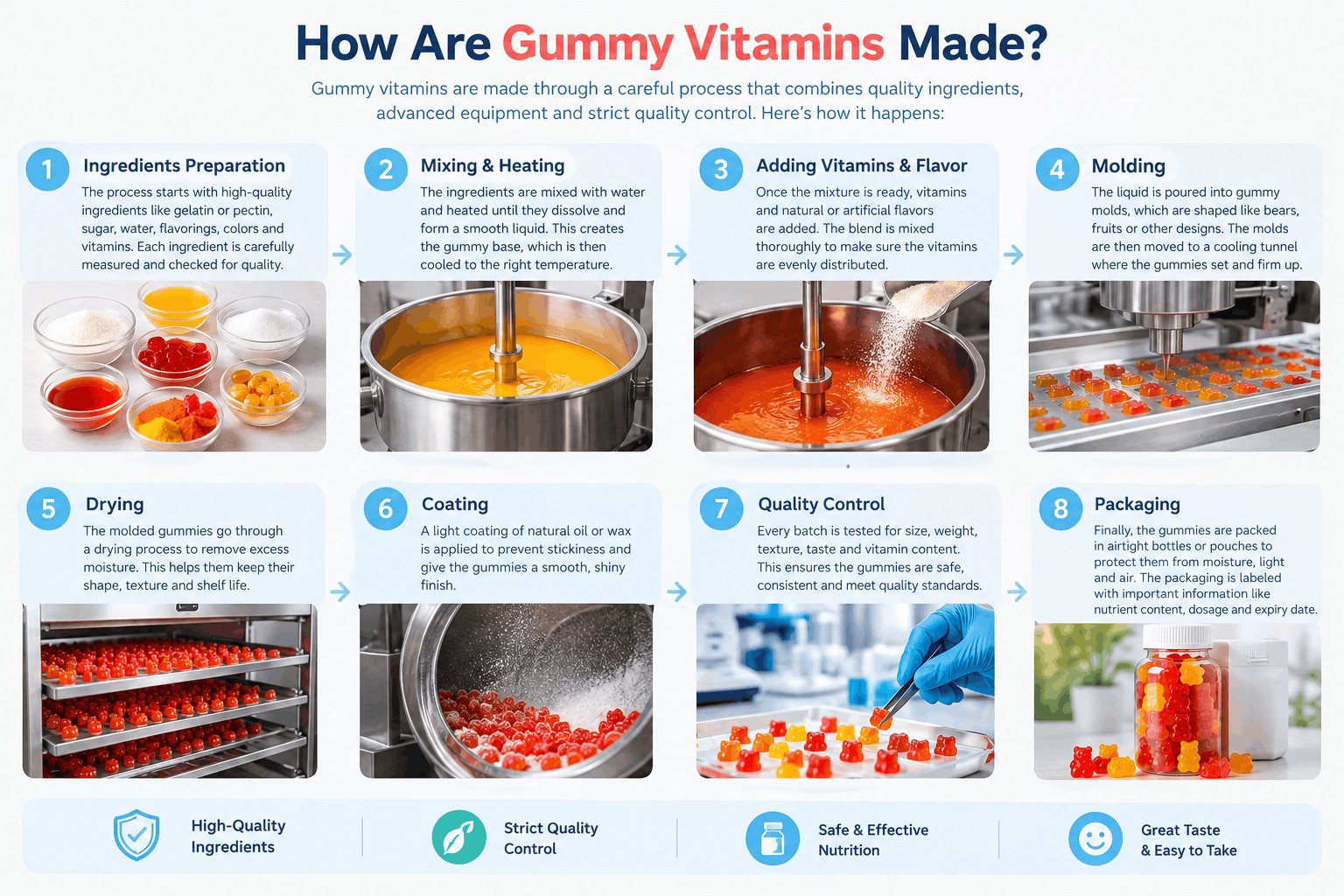
Gummy vitamins are made in eight steps: compounding, cooking, adding actives, depositing, setting, finishing, testing and packaging. A factory weighs the ingredients, cooks the gel base, blends in vitamins and flavour, deposits the mixture into moulds and lets it set. It then polishes, tests and packs the gummies.
1. Compounding. Weigh the gelling agent, sweeteners, water and other ingredients against the formula.
2. Cooking. Heat the mixture until the gelling agent dissolves and the batch reaches its target solids. Factories usually add gelatin as a solution after cooking, because long heat can degrade it.
3. Adding actives, flavour, colour and acid. Blend heat-sensitive vitamins, flavour and colour late, so they spend less time hot. Acid helps pectin set.
4. Depositing. Pour the batch into moulds shaped in starch or silicone.
5. Setting. Hold the filled moulds in a conditioning room until the gummies firm up.
6. Demoulding and finishing. Remove the pieces, clear off excess starch, then coat them with oil or wax so they do not stick together.
7. Testing. Check weight, appearance, moisture and active content, and release the batch only against a certificate of analysis (COA).
8. Packaging. Fill jars, pouches or bottles, seal, label and ship.
Numbers to know
| Item | Number | Source |
| Gelling agent share of a gummy | About 5 to 8% | USP presentation |
| Setting and conditioning time | 24 to 48 hours in many processes | US patent 12,144,365 |
| Fast-setting pectin formulas | 2 to 12 hours | US patent 12,144,365 |
| Order production time | 15 to 30 business days, then freight | Youdi Nutrition product pages |
| Shared batch minimum | 100 units per brand; runs at 500 combined units | Youdi Nutrition shared MOQ page |
What are gummy vitamins made of?
A gummy vitamin contains a gelling agent, sweeteners, water, acid, flavour, colour, vitamins or other actives, and a finishing coat. The gelling agent, pectin or gelatin, forms the chewy network and makes up about 5 to 8% of the recipe, according to a USP presentation on chewable gels.
| Component | Role | Note |
| Gelling agent | Builds the chewy gel network | Pectin is plant-based. Gelatin is animal-based. |
| Sweeteners and syrups | Sweetness, bulk and texture | Sugar-free versions use sweeteners such as stevia and monk fruit. |
| Water | Dissolves ingredients and carries heat | Much of it leaves during cooking and setting. |
| Acid (such as citric acid) | Tartness and set control | Helps pectin set. Vitamin C is itself an acid and can change set timing. |
| Flavour and colour | Taste and appearance | Natural colours can fade with heat. |
| Vitamins and actives | The nutrition | Heat, light and pH can degrade some vitamins. |
| Finishing coat | Stops pieces sticking | Oil or wax coating. |
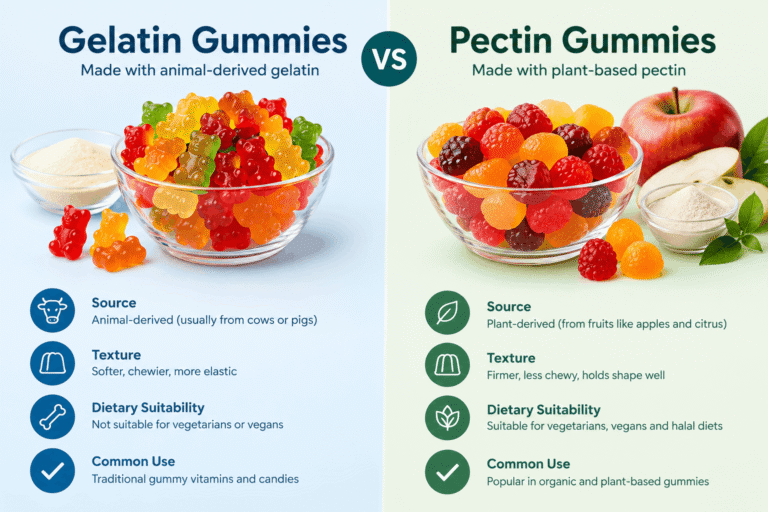
What is the difference between pectin and gelatin gummies?
Pectin is plant-based and gelatin is animal-based, and they behave differently in the factory. Gelatin can degrade under long heat, so factories add it as a solution after cooking. Pectin tolerates heat but has a high-temperature gelling point, so it needs tighter control, according to Roquette’s technical guide.
| Factor | Pectin gummies | Gelatin gummies |
| Source | Plant-based | Animal-based |
| Heat behaviour | Heat stable; gels at a high temperature | Can degrade with long high heat; added after cooking |
| Process control | Tighter control of set and pH; cannot be melted down and reworked | More forgiving to make, per a formulator quoted by SupplySide |
| Dietary fit | Suits vegan buyers and removes the gelatin question for halal | Needs a sourcing check for halal and no fit for vegan |
Gummies from Youdi Nutrition are pectin-based, gelatin-free and vegan-friendly. Our halal certificate comes from the Halal Development Institute of Indonesia. See the assorted gummy bears for the classic format. Who this is not for: if you want the elastic bounce of gelatin, test samples first, because pectin chews differently.
How does depositing gummies into moulds work?
Depositing pours the hot gummy mixture into moulds so it takes a shape. Most factories use a starch mogul, a machine that makes shaped candies from syrups or gels, or silicone moulds. In a starch mogul, shapes are impressed into trays of corn starch before the mixture is deposited, as the patent above describes.
| Method | How it works | Good to know |
| Starch mogul | Shapes are impressed in corn starch trays and the mixture is deposited into them | Standard for high volume; starch also holds the piece while it sets |
| Silicone moulds | The mixture is deposited into reusable cavities; oil on the mould helps demoulding | Common for smaller runs and detailed shapes |
| Starchless depositing | Moulds are used without a starch bed | Needs significant equipment investment |
A new shape needs new tooling, so ask about mould terms before you design a shape. Youdi Nutrition produces custom shaped gummies and filled gummies with a firmer shell and a softer centre.
How long does it take to make gummy vitamins?
One gummy batch sets for 24 to 48 hours in many processes, and a full order at Youdi Nutrition typically takes 15 to 30 business days of production before freight. A batch is one production run. An order adds scheduling, testing and packaging, which is why the two numbers differ.
| Stage | Typical time | Source |
| Setting and conditioning | 24 to 48 hours in many processes; fast-setting pectin formulas can set in 2 to 12 hours | US patent 12,144,365 |
| Order production | 15 to 30 business days, depending on formulation and packaging complexity | Youdi Nutrition product pages |
| Samples | Free sample production is step 3 of the OEM process | Youdi Nutrition manufacturing page |
| Freight | Air or sea, after production | Youdi Nutrition |
Slower-setting formulas, humid rooms and complex packaging add days. Ask your factory for the setting time of your formula before you plan a launch date.
How do manufacturers keep vitamin doses accurate in gummies?
Manufacturers add a small extra amount of some vitamins, called overage, to offset losses from heat and storage, then confirm the finished dose by testing. The USP notes that manufacturers regularly add extra nutrients to chewable gels to compensate for loss. Ask for finished-product COAs and stability data.
Vitamin C shows why. It is an acid, and adding it can make a gummy base set too firmly or at the wrong time, according to formulators quoted by SupplySide. The same report describes testing by NOW Foods and Alkemist Labs in which vitamin C gummies did not contain the amount on the label.
Ask whether the factory uses overage and how it verifies the finished dose.
• Request a finished-product COA for each batch, not only a raw-material COA.
• Request stability data that covers the full shelf life.
• Send a retained sample to an independent lab before you launch.
What quality checks happen during gummy production?
Good gummy production checks quality at six points: raw material intake, cooking, depositing, setting, finished product and packaging. Each check produces a record. In the US, 21 CFR Part 111 requires a master manufacturing record, a batch production record, laboratory operations and reserve samples.
| Stage | What is checked | Record |
| Raw material intake | Identity and condition of each ingredient | Receiving record |
| Cooking | Solids, measured as Brix, and batch temperature | Batch production record |
| Depositing | Piece weight and shape | In-process check log |
| Setting | Moisture and water activity | Conditioning record |
| Finished product | Active content, appearance and microbial results | Certificate of analysis (COA) |
| Packaging | Seal, label and lot code | Packaging record |
Youdi Nutrition runs in-process quality control and batch traceability from raw materials to finished goods, and third-party COAs are available for every batch. Our certificates include NSF/ANSI 455-2 GMP, HACCP and FSSC 22000. Review them on our quality page.
How gummy vitamins are made in the USA, and is it different overseas?
The process is the same in any country: cook, deposit, set, finish, test and pack. What changes is the legal framework. Gummy vitamins sold in the US must be made under the FDA’s CGMP rule, 21 CFR Part 111, and labelled under FDA rules, wherever the factory sits.
The FDA does not approve dietary supplements for safety or effectiveness before they are sold. The company marketing the product must make sure it is safe and that its claims are truthful, per the FDA dietary supplement guidance. Other markets set their own rules, so confirm ingredient and label requirements before you finalise a formula.
Who this is not for: if a retailer requires US-located manufacturing, choose a US-based factory. A China-based factory such as Youdi Nutrition is not the right fit for that requirement.
How are vegan, sugar-free and halal gummy vitamins made?
Vegan and halal gummies replace gelatin with a plant-based gelling agent, usually pectin. Sugar-free gummies replace sugar with other sweeteners, such as stevia and monk fruit in Youdi Nutrition’s sugar-free options. Each swap changes cooking and setting, so the factory adjusts the recipe and tests a sample.
Halal needs more than the gelling agent. Flavours, colours and processing aids also need checking, and the certificate must cover the product format. Sugar reduction is a known formulation challenge, because sugar adds bulk and texture.
Protein gummies add another variable. See our protein gummies in single-serve pouches.
| Swap | What changes | What the factory adjusts |
| Gelatin to pectin | Heat behaviour and set control | Acid level, cooking and setting conditions |
| Sugar to stevia and monk fruit | Bulk and texture | Formula balance and sample testing |
| Standard to halal | Ingredient-level checks | Flavours, colours, processing aids and certificate scope |
What problems can happen during gummy production?
Four problems recur in gummy production: gummies that do not set, pieces that stick together, colours that fade and potency that falls below the label claim. Each one traces to a step in the process: acid and pH for set, coating and humidity for sticking, heat for colour, and heat plus storage for potency.
• Soft or uneven set: check the acid level, the cooking end point and the setting time.
• Sticking: check the finishing coat and the humidity of the packing room.
• Faded colour: add natural colours late, because they fade with heat.
• Low potency: ask about overage, finished-product COAs and stability data.
A good factory tracks these problems in its batch records and fixes the cause, not the symptom.
What should you ask a gummy manufacturer before ordering?
Ask eight questions before you order, and get written answers. They cover the gelling agent, dose accuracy, testing, moulds, setting time, certificates, MOQ and formula ownership. A factory that cannot answer them within a few days is a risk for your first batch.
1. Which gelling agent do you use, and why?
2. Do you use vitamin overage, and how do you verify the finished dose?
3. Can I see a finished-product COA and stability data?
4. Which depositing method and moulds do you use, and what are the tooling terms for a custom shape?
5. What are the setting time and the water activity target for my formula?
6. Which certificates cover the facility, and what are their scope and expiry dates?
7. What are the MOQ routes and the lead time?
8. Who owns the formula, and can I move it to another factory?
At Youdi Nutrition, a shared batch starts at 100 units per brand and runs once combined orders reach 500 units. A market-test order starts at 200 units, and full custom production starts at 500 units. See the shared MOQ program for current batches, and read the FAQ for sample and quality questions.
Frequently asked questions
How long do gummy vitamins take to set?
In many processes gummies set for 24 to 48 hours, depending on mould type, formula, temperature and humidity. Some fast-setting pectin formulas set in 2 to 12 hours. Setting is usually the longest step in large-scale production.
Why do gummy vitamins contain extra vitamins?
Manufacturers add an extra amount of some nutrients, called overage, to offset losses during manufacturing and storage. The finished gummy should still be tested against the label claim, so ask your factory for a finished-product COA.
Are gummy vitamins made with gelatin?
Gelatin and pectin are the two main gelling agents. Gelatin is animal-based and pectin is plant-based. Youdi Nutrition makes pectin-based, gelatin-free, vegan-friendly gummies.
Can gummy vitamins be made without sugar?
Yes. Factories replace sugar with other sweeteners, such as stevia and monk fruit in Youdi Nutrition’s sugar-free options. Sugar reduction changes texture and setting, so test a sample before you commit to a batch.
What is a starch mogul?
A starch mogul is a machine that makes shaped candies or candy centers from syrups or gels, such as gummy candy. It deposits the hot mixture into shapes impressed in trays of starch, where the pieces are set.
How are vitamin gummies made for a small first order?
Through a shared batch: two or more brands order the same production run, and each brand uses its own approved label. At Youdi Nutrition, a shared batch starts at 100 units per brand and runs once combined orders reach 500 units.
Ready to see how your gummy vitamin would be made?
So, how are gummy vitamins made? In eight controlled steps, each with a check and a record. Send Youdi Nutrition your target dose, flavour and market, and our team will explain how your formula would be made, from consultation and free sample production to production and worldwide shipping. Browse our product formats or contact our team for a free formula consultation.