To start a supplement business, pick one product format and one customer group, choose a compliant formula, find a certified manufacturer, approve a sample, finalise a legal label, and place a first order. With a shared-batch factory, that first order can be as small as 100 units.
This guide on how to start a supplement business is for first-time founders, wellness brands adding a product line, and agencies building a private label range for a client. You will get a nine-step plan, a document checklist for vetting manufacturers, and the real MOQ routes we run at Youdi Nutrition, a GMP, HACCP, FSSC 22000 and halal certified supplement manufacturer in China.
How to start a supplement business: what are the nine steps?
You start a supplement business in nine steps: define your customer, check the rules in your market, pick a format, choose a formula route, shortlist manufacturers, test samples, finalise the label, place a first order, and track sales before reordering. Most delays come from steps 2 and 7, so begin legal and label checks while samples are being made.
1. Define one customer and one problem. “Adults who dislike swallowing capsules” is a product brief. “Everyone who wants better health” is not.
2. Check the rules in each market. The US, the EU and Gulf countries regulate supplements differently, and an ingredient that is legal in one can be restricted in another.
3. Pick a format. Gummies suit customers who dislike pills. Capsules and softgels suit high-dose actives. Liquid drops and jelly sticks suit fast absorption and on-the-go use.
4. Choose a formula route. Use a stock formula, adjust one, or develop a custom formula. Each route trades speed against control.
5. Shortlist three manufacturers. Request certificates, a sample COA, a written MOQ and a lead time from each.
6. Test samples. Check taste, texture, colour, dose and packaging fit. If you ship to warm climates, leave a sealed gummy sample in a warm room for a week to see whether pieces stick together.
7. Finalise the label and claims. Have a regulatory adviser review the Supplement Facts panel and every claim.
8. Place a first order sized to demand. Small batches protect cash while you learn what customers buy.
9. Track sales, then reorder. Reorder the flavours that sell and drop the ones that do not.
Our one-stop supplement manufacturing service covers steps 4 to 8 under one roof: formulation, sampling, production, private label packaging and worldwide shipping.
How much does it cost to start a supplement business?
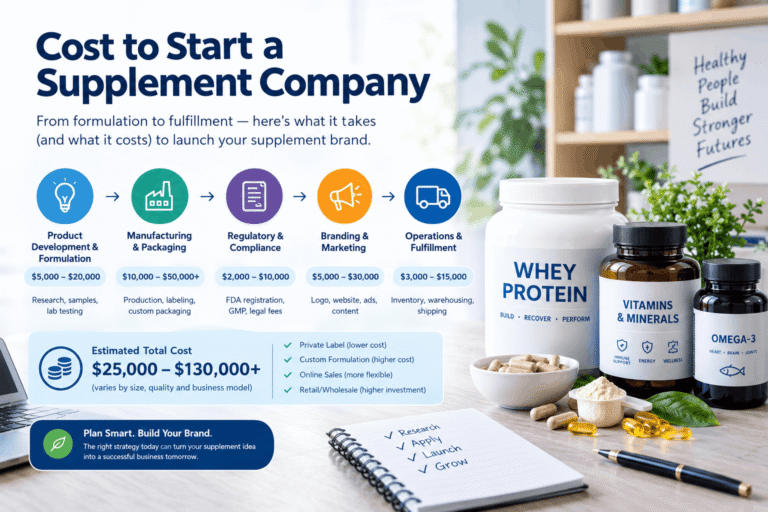
Your first-order cost equals units multiplied by unit price, plus fixed costs for label design, legal review, testing, shipping and marketing. Unit price depends on format, ingredients and quantity. The number you control is order size. At Youdi Nutrition, a first order starts at 100 units in a shared batch, 200 units as a market test, or 500 units for full custom production.
| Cost item | What drives it | How to keep it low |
| Product units | Format, ingredient cost, order quantity | Start with a shared batch or market-test order |
| Formula development | Custom actives, dose, flavour | Begin with an adjusted existing formula |
| Label and packaging design | Number of flavours, pouch or jar type | Use standard packaging for the market test |
| Legal and label review | Number of markets, claims on pack | Limit claims to what you can substantiate |
| Testing and COA | Number of batches, parameters tested | Request a sample COA before ordering |
| Shipping and import | Air or sea freight, destination duties | Compare both modes for your order size |
What are the MOQ routes for a first supplement order?
There are three common routes: a shared batch, a market-test order and a full custom run. At Youdi Nutrition, a shared batch starts at 100 units per brand and runs once combined orders reach 500 units. A market-test order starts at 200 units with standard packaging. A full custom run starts at 500 units.
| Route | Minimum | Packaging and label | Best for | Trade-off |
| Shared batch | 100 units per brand | Your own approved label | Testing flavour and demand cheaply | Batch starts only after combined orders reach 500 units |
| Market-test order | 200 units | Standard packaging | Validating demand before custom packs | Less brand differentiation on pack |
| Full custom run | 500 units | Custom formula and packaging | Brands with a proven product | Highest cash commitment |
In a shared batch, two or more brands order the same production run and each brand uses its own approved label. That makes shared batches the closest option to white label, so confirm what you can adjust.
Who this is not for: if you need an exclusive formula from day one, skip the shared batch and ask for a full custom run. See the shared MOQ program for current batches.
Do you need FDA approval to sell supplements?
No. In the United States, the FDA does not approve dietary supplements for safety or effectiveness before they are sold. Under the Dietary Supplement Health and Education Act of 1994 (DSHEA), the company that markets the product must make sure it is safe and that its label claims are truthful and substantiated, according to the FDA dietary supplement guidance.
Manufacturing falls under the FDA’s current good manufacturing practice (CGMP) rule, 21 CFR Part 111, which covers manufacturing, packaging, labeling and holding of dietary supplements. The FDA reports manufacturing problems linked to supplements, including undeclared ingredients, subpotency and contamination. Read the FDA’s CGMP rule backgrounder for the details.
The Federal Trade Commission (FTC) polices advertising. Its Health Products Compliance Guidance explains how health claims must be substantiated, for supplements and other health products.
One trap: a factory with FDA facility registration is not an FDA-approved factory. Registration records that a facility exists. It does not certify quality.
What rules apply if you sell supplements in more than one country?
Each market has its own supplement law, so check the rules before you lock a formula. The US relies on DSHEA and 21 CFR Part 111. The EU regulates food supplements under Directive 2002/46/EC. The Gulf states, the UK and Asia-Pacific markets set their own ingredient and labeling rules.
The EU directive permits only the vitamins and minerals listed in Annex I, in the forms listed in Annex II. A formula built for the US may therefore contain a vitamin form that the EU does not allow. Send your target countries to the manufacturer before sampling, not after.
What is the difference between private label, white label, OEM and ODM?
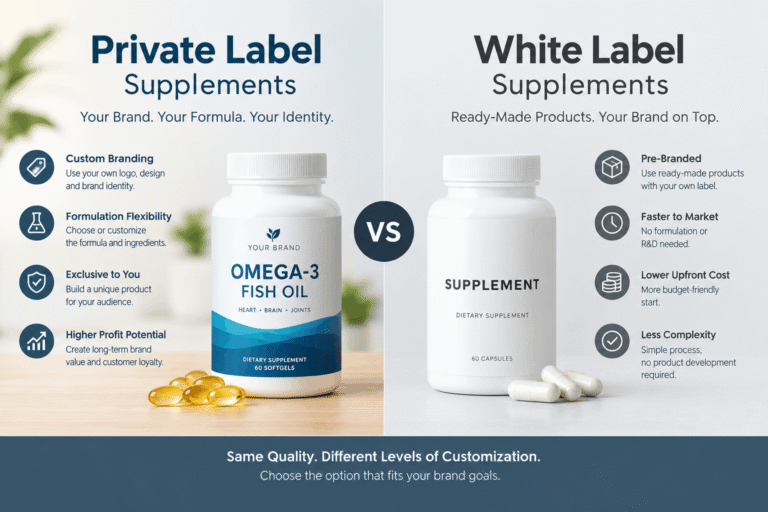
Private label supplements are products made by a contract manufacturer and sold under your brand, usually with a formula created or adjusted for you.
White label supplements use a stock formula that the manufacturer already sells to two or more brands, with your label applied.
OEM means you bring the formula or specification and the factory makes it. ODM means the factory develops or supplies the formula and you sell it under your brand.
| Model | Who supplies the formula | Customisation | Speed to first order |
| White label | Manufacturer, shared with other brands | Low: label and flavour options | Fastest |
| Private label (ODM) | Manufacturer, adjusted or developed for you | Medium to high | Moderate |
| OEM | You | High: your own formula | Slowest; the factory must match and test your formula |
Sellers use these terms loosely. Before you sign, ask three questions in writing: Is this formula sold to other brands? Who owns it? Can I move it to another factory?
How do you choose the best private label supplement manufacturer?
Choose a manufacturer by checking documents, not websites. Ask for current certificates, a sample third-party certificate of analysis (COA), a written MOQ and lead time, and a clear statement on formula ownership. A supplier that cannot show these within a few days is a risk for your first batch. Ranking lists of the best private label supplement manufacturers rarely show these documents, so request them yourself.
Which documents should you ask for?
1. A GMP certificate that names the issuing body, the scope and the expiry date.
2. Food safety certificates such as HACCP and FSSC 22000.
3. A sample COA with a batch number, active content results and key quality parameters.
4. A halal certificate if you sell to Muslim-majority markets.
5. A written quote that lists MOQ, price breaks, lead time and sample policy.
6. A confidentiality agreement and a written statement on formula ownership.
What does a complete certificate set look like?
As a reference, Youdi Nutrition lists an NSF/ANSI 455-2 GMP certificate for dietary supplements, HACCP, FSSC 22000, a halal certificate from the Halal Development Institute of Indonesia, and a US FDA food facility registration. Third-party COAs are available for every batch. Review the set on our quality page and read the FAQ for how to request copies.
Is the best white label supplement manufacturer different from the best private label vitamin manufacturer?
The best choice depends on your format and formula route, not on a ranking. A white label manufacturer fits you if a stock formula meets your needs and speed matters. A private label vitamin manufacturer fits you if you need control over dose, flavour or ingredients. Judge both on the same document list above.
How do you make private label halal supplements?
Private label halal supplements need three things: halal-suitable ingredients, a manufacturer whose halal certificate covers your product, and documents that your destination market accepts. Gelatin and alcohol-based flavour carriers are common problems, so pectin-based gummies and HPMC capsules, which are plant-derived, are practical starting points.
Pick your target markets first. Halal certifiers differ, and a market may recognise only certain bodies.
1. Request ingredient-level halal statements. Cover flavours, colours, capsule shells and processing aids, not just the active.
2. Verify the certificate. Check the issuing body, scope and expiry date, and confirm it covers your product format.
3. Confirm label rules. Ask the certifier whether your brand may print a halal mark and under what conditions.
At Youdi Nutrition, gummies are pectin-based, gelatin-free and vegan-friendly. Our halal certificate comes from the Halal Development Institute of Indonesia. Who this is not for: if your market requires a specific national halal mark, confirm that the certifier is recognised there before you order. See all product formats.
How long does it take to launch a supplement brand?
A first launch takes from idea to shipped units, because sampling, label review and shipping run one after another. At Youdi Nutrition, production alone typically takes 15 to 30 business days, depending on formulation and packaging complexity, followed by air or sea freight.
Run label review in parallel with sampling. It is the cheapest way to shorten the schedule.
What can you claim on a supplement label?
You can make structure/function claims, which describe how a nutrient affects normal body function, but you cannot claim that a supplement treats, cures or prevents a disease. In the US, labels carrying a structure/function claim must show the standard FDA disclaimer, and every claim needs evidence behind it.
| Claim type | Example | Allowed on a supplement? |
| Structure/function | “Calcium helps build strong bones” | Yes, with the FDA disclaimer and substantiation |
| Disease claim | “Prevents osteoporosis” | No |
The FTC applies the same substantiation expectations to advertising, including testimonials and endorsements, so your marketing carries the same burden as your label. Have a regulatory adviser check every claim before print. This guide is general information, not legal advice.
What mistakes do first-time supplement founders make?
Common mistakes include ordering too many units before demand is proven, choosing a factory on unit price alone, and skipping label review. Each one is avoidable with a small first order and a document check.
• Ordering too many units. Stock you cannot sell ties up cash. Start with 100 to 200 units and reorder on data.
• Choosing on unit price alone. A low price with a high MOQ can cost more than a higher price at a small MOQ.
• Skipping label review. A wrong claim can force a reprint and block sales.
• Treating FDA registration as approval. It is not.
• Ignoring destination rules. A formula that is legal in one market may be restricted in another.
• Not asking who owns the formula. Without a written answer, you may be unable to move production later.
Frequently Asked Questions
How much money do I need to start a supplement business?
It depends on your format, formula and order size. The first batch is your largest cost, plus fixed costs for labels, legal review and shipping. First orders at Youdi Nutrition start at 100 units in a shared batch. Request a written quote for exact pricing.
How do I start my own supplement company with no experience?
Work with an OEM or ODM manufacturer that handles formulation, production and packaging, and hire a regulatory adviser for claims and labels. You still own the brand, the customer relationship and the compliance of your marketing. Begin with one format and a small test order.
Is private label the same as white label?
Not always. Private label usually means a formula made or adjusted for your brand. White label usually means a stock formula that two or more brands sell under their own labels. Suppliers use both terms loosely, so confirm formula exclusivity and ownership in writing before you order.
Do I need a license to sell supplements?
Requirements depend on your country and state. In the US, the FDA does not approve supplements before sale, but you must follow labeling, CGMP and advertising rules. You also need a registered business and any local sales permits.
How do I know a halal certificate is real?
Check the issuing body, the certificate scope and the expiry date. Then confirm that the certificate covers your product format and that your target market recognises the certifier. Ask the certifier directly if you are unsure. Youdi Nutrition’s halal certificate comes from the Halal Development Institute of Indonesia.
Ready to plan your first batch?
You now have the outline of how to start a supplement business without a large first order. Tell us your format, target market and budget, and our team will confirm formula options and the right MOQ route. Browse our product formats, read how shared MOQ batches work, or contact our team for a free formula consultation.
Limits of this guide: it summarises public regulatory sources and our own manufacturing practice. It is not legal advice, and rules change. Confirm current requirements with a qualified regulatory adviser before you print labels.
3 Responses