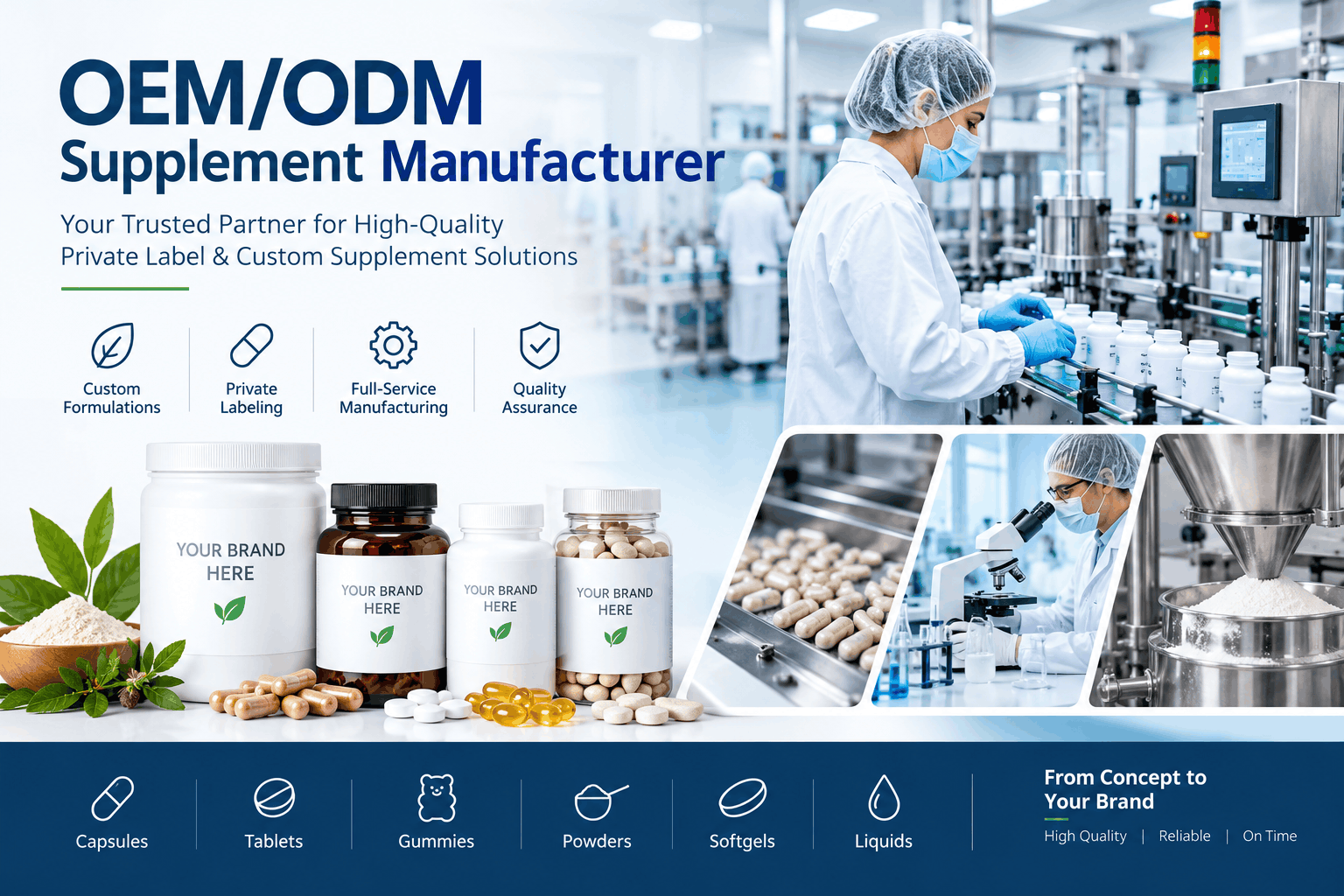
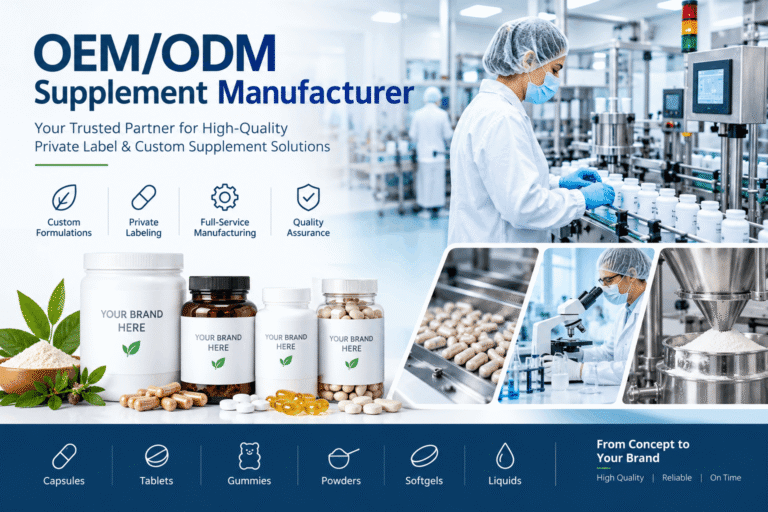
An OEM/ODM supplement manufacturer is a contract factory that makes dietary supplements for other companies to sell under their own labels. Under OEM, you bring the formula. Under ODM, the factory develops it with you. Pick one by checking four things: certifications, minimum order quantity, product formats and batch testing. This guide is for founders and buyers comparing supplement manufacturers for a first or second product. After reading, you can score any candidate with a ten-question checklist, choose the right order route for your budget, and know which documents to request before paying a deposit.
What is an OEM/ODM supplement manufacturer?
An OEM/ODM supplement manufacturer is a factory that produces supplements for brands that do not own a plant. OEM means original equipment manufacturing: the brand supplies the formula and the factory makes it. ODM means original design manufacturing: the factory supplies a tested formula, and the brand chooses flavour, dose and packaging.
Most contract supplement manufacturers run both models side by side. A brand with a finished formula uses OEM. A brand with only an idea, such as a magnesium and L-theanine gummy, uses ODM and approves sample formulas. Either way, the brand owns the label and the customer relationship. The factory handles raw material sourcing, production and batch records. Check label claims with a regulatory adviser before you finalize them, because the brand that sells the product answers for them.
What is the difference between OEM and ODM in supplements?
OEM gives you full control of the formula. ODM gives you speed, because the factory starts from formulas it already runs. Choose OEM if you own a proprietary or clinically backed formula. Choose ODM if you are testing a new category and want the factory to guide dose, flavour and texture.
| Factor | OEM | ODM |
| Who supplies the formula | The brand | The factory, adjusted to the brand brief |
| Best for | Brands with a proprietary formula | New brands testing a product idea |
| Main benefit | Full control over ingredients and doses | Faster start and less development work |
| Main risk | Formula may need changes to hold texture or stability at scale | Similar base formula may appear in other brands |
| Contract point to settle | Who may keep and reuse the formula | Who owns the final adjusted formula |
Settle formula ownership in writing under either model. Ask whether the factory may sell the same formula to another brand.
How does the OEM/ODM process work from idea to shipment?
The process has six steps: brief, formula review, sample, label approval, production and shipping. A clear brief shortens every later step. Youdi Nutrition accepts briefs through its contact form, WhatsApp or Alibaba store and replies with formula options, an order route and next steps.
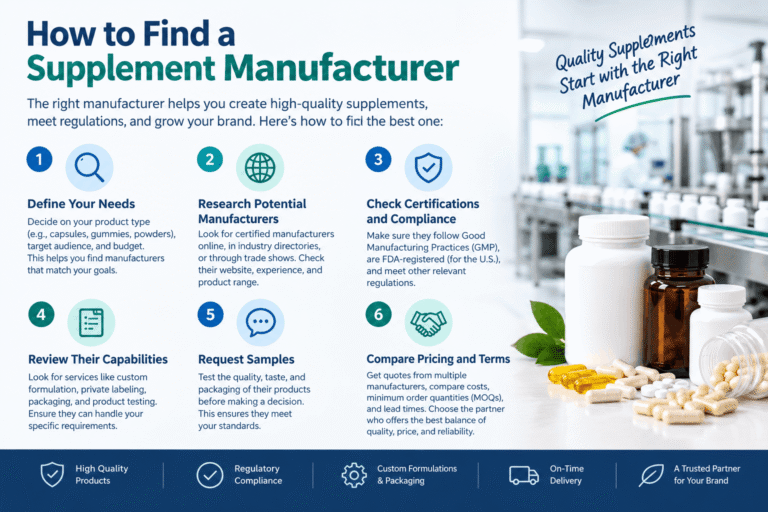
1. Send a brief. State the format, active ingredients, doses, target country and claims such as vegan or sugar-free.
2. Review the formula. The factory confirms what works in that format and flags clashes, such as a high dose that will not fit in one gummy.
3. Test a sample. Check flavour, look and texture before any production run.
4. Approve the label. Match the ingredient list, serving size and statements to the formula and the target market.
5. Run the batch. Mixing, depositing or filling, quality control and packing follow written batch records.
6. Verify and ship. Read the COA, then arrange shipping to your warehouse or fulfilment centre.
Which certifications should a supplement manufacturing partner hold?
A supplement manufacturing partner serving the US market should hold a GMP certification audited against 21 CFR Part 111, a food safety certificate such as HACCP or FSSC 22000, and an FDA facility registration. Add Halal if you sell in Muslim-majority markets. No certificate proves quality alone. The batch COA does.
21 CFR Part 111 requires anyone who manufactures, packages, labels or holds a dietary supplement to establish and follow current good manufacturing practice. FDA published the final rule in June 2007. The NSF/ANSI 455-2 standard defines an audit method for checking compliance with Part 111 and adds retailer requirements.
| Credential | What it covers | What it does not prove |
| NSF/ANSI 455-2 GMP | Dietary supplement GMP audit based on 21 CFR 111 | That your specific formula is effective or safe at your dose |
| HACCP | Hazard analysis and critical control points in food production | Supplement-specific GMP records |
| FSSC 22000 | Food safety management system certification | Label claims or formula quality |
| Halal | Compliance with Halal rules from the issuing body | Anything beyond Halal status |
| FDA facility registration | The facility is registered with FDA | FDA approval. FDA does not approve the facility or the product |
By the numbers
• June 2007: FDA published the final dietary supplement cGMP rule (21 CFR Part 111). Source: Federal Register.
• 12 July 2002: Directive 2002/46/EC on food supplements entered into force. Source: European Parliament Legislative Observatory.
• 100, 200 and 500: the unit thresholds for shared, market-test and full custom orders at Youdi Nutrition. Source: youdinutrition.com.
• 5: the credentials displayed on the Youdi Nutrition homepage. Source: youdinutrition.com.
How do you spot the best supplement manufacturers?
The best supplement manufacturers show documents before they make promises. They name the body that issued each certificate, send a sample COA, state their minimum order in writing and tell you who owns the formula. They also say no to formulas that will not work. Lists of top supplement manufacturers usually rank by size. A new brand should rank by fit.
Use this scorecard with every candidate. Give one point for each strong answer. Treat anything under eight points as a reason to keep searching.
| Ask this | Strong answer | Weak answer |
| Which body issued your GMP certificate? | Names the body and shares the certificate | “We follow GMP” with no document |
| Can I see a sample COA? | Shows a real COA with active content and quality tests | Offers a generic template |
| What is your minimum order? | Gives a figure per route, in writing | “It depends” with no range |
| Who owns the formula? | Answers in the contract | Avoids the question |
| Can I taste a sample first? | Yes, before production | Sample only after deposit |
| How do you trace a batch? | Raw material to finished goods records | No batch number system |
| Which markets have you shipped to? | Names regions and explains label needs | Says “everywhere” |
| What can you not make? | Names formula limits for the format | Never says no |
| Who handles label review? | Checks the label against the formula | Prints whatever you send |
| Where is the factory? | Gives one consistent address on every channel | Address differs between pages |
What minimum order quantity should a new brand expect?
Factories that only take large orders leave new brands guessing, but a new brand can start small. Youdi Nutrition offers four routes: samples, market-test orders from 200 units, shared production from 100 units per brand, and full custom production from 500 units. Pick the route that matches how much demand you have already proven.
| Route | Minimum | What you get | Best for |
| Samples | None stated | Taste, texture and look checks before a run | Every new brand |
| Market-test order | 200 units | A small run in standard packaging or white label | Testing customer demand |
| Shared production | 100 units per brand | A place in a batch shared by several brands, each with its own approved label | Lowest first investment |
| Full custom production | 500 units | Custom formula, flavour, dosage and printed packaging | Proven products ready to scale |
In shared production, the batch starts once total quantity across brands reaches 500 units. That means your start date depends partly on other brands. Ask for an expected start window before you pay. The shared MOQ page explains the program.
Which product formats can an OEM supplement manufacturer produce?
Youdi Nutrition produces gummies, capsules, softgels, powders, liquid drops and jelly sticks. Gummies are its core format. Choose a format by dose size, target customer and how people will take the product each day, not by trend.
• Gummies: pectin-based, gelatin-free and vegan options, with sugar-free versions sweetened with stevia and monk fruit. See gummy bears, custom-shaped gummies and protein gummies.
• Capsules and softgels: suited to high-dose actives. See capsules and softgels.
• Liquid drops: dropper bottles with accurate dosing for adults and kids. See liquid drops.
• Jelly sticks: single-serve sticks that are easy to carry. See jelly sticks.
• Powders: flavoured, protein, greens and functional blends in sachets, stick packs or jars.
The full range sits on the products page. A single OEM supplement manufacturer that covers several formats lets you add a capsule or powder later without changing partners.
What rules apply to supplement manufacturers in Europe, or to brands selling there?
In the EU, food supplements fall under Directive 2002/46/EC. It allows supplements on the market only if they follow its rules, and it limits vitamins and minerals to those listed in its annexes, in the listed forms. Brands selling into Europe must check ingredients, doses and labels against EU law before production, not after.
The Directive applies to supplements sold as foodstuffs and excludes medicinal products. Regulation (EC) 1925/2006 separately harmonises rules on adding vitamins, minerals and certain other substances to food. The Directive harmonises vitamins and minerals first, so other ingredients, including many botanicals, may fall under national rules. Some brands prefer supplement manufacturers in Europe for shorter shipping. Others choose a factory in Asia for flexible minimums. Both routes work if the formula and label meet the rules of the destination country. State your target countries in the brief.
Do herbal supplement manufacturers work differently?
Yes. Herbal supplement manufacturers handle plant ingredients that vary by species, plant part, harvest and extraction method. Ask for botanical identity testing, the extract ratio or standardization marker, and contaminant testing, such as heavy metals and microbes, on the COA.
21 CFR 111.75 addresses how manufacturers verify components before use, so ask how the factory confirms a botanical is the plant on the label. Youdi Nutrition builds gummy formulas around vitamins, minerals, botanicals, magnesium and L-theanine, then adjusts flavour and texture until the product is pleasant to take every day. Ask any herbal supplement manufacturer which extracts it has run before and request the matching COA.
Is an OEM/ODM supplement manufacturer right for your brand?
Yes, if you want to sell supplements without owning a factory. You trade some control for speed and lower capital cost. It is a poor fit if you need a factory in one specific country, plan medical or drug claims, or cannot fund testing of your final product.
Pros
• No equipment spend, since the factory already owns the production line.
• Faster launch from formula to finished goods.
• Access to a certified facility and batch records.
• Small test runs reduce the cost of a wrong guess.
Cons
• Less control over production schedules.
• Formula ownership needs a clear contract.
• Overseas shipping adds lead time and import steps.
• The brand still answers for label claims and market compliance.
Who this is not for
Brands that must produce inside the EU, brands that need pharmaceutical-grade production, and brands that want to own the manufacturing equipment should look at other models. Youdi Nutrition is a China-based manufacturer, so a European-made label is not something it can offer.
Why choose Youdi Nutrition as your OEM/ODM supplement manufacturer?
Youdi Nutrition suits emerging brands that want a certified partner with low minimums, gummy expertise and several formats under one roof. It lists NSF GMP (NSF/ANSI 455-2), HACCP, Halal and FSSC 22000 credentials, holds an FDA facility registration, and makes third-party COAs available on request. Superior supplement manufacturing, in practice, means documented control at each step. It is not a slogan.
Production runs through a GMP-built cleanroom floor with mixing and filling, gummy depositing, in-process quality checks, and bottling and capping. Records trace each batch from raw materials to finished goods. Read the quality page for the credentials and the manufacturing page for the line. Compare it with other options in 10 best private label supplement manufacturers in 2026. If you are still shaping the business, read how to start a supplement brand and how to start a supplement business first.
Frequently Asked Questions
What does OEM/ODM mean for supplements?
OEM means the factory makes your formula. ODM means the factory develops a formula with you. Both produce supplements sold under your brand. Many contract supplement manufacturers offer both, so you can start with an idea and later move to your own formula.
What is the minimum order from an OEM/ODM supplement manufacturer?
It varies by factory. At Youdi Nutrition, shared production starts from 100 units per brand, market-test orders from 200 units and full custom production from 500 units. Always get the figure for your format in writing before you pay.
Is FDA registration the same as FDA approval?
No. FDA registration means a facility is listed with the agency. It does not mean the FDA approved the facility or your product. Treat registration as one data point and ask for GMP audit evidence and a batch COA as well.
Can I get a sample before I place an order?
Yes. Youdi Nutrition offers sample testing so you can check taste, texture and look before a production run. Ask for the sample to match your target format and sweetener choice, such as a sugar-free gummy.
Will a contract supplement manufacturer keep my formula private?
Only if the contract says so. Ask for a confidentiality agreement and a clause stating who owns the final formula and whether the factory may sell it to others. Do this before you share your formula.
Can a factory in China make supplements for Europe?
Yes, if the formula and label meet the rules of the destination country. For the EU, check Directive 2002/46/EC and national rules on ingredients and doses. Name your target countries in your first brief.
What should you do next?
Write a one-page brief with your format, active ingredients, doses, target country and the order route you want. Send it to two or three candidate OEM/ODM supplement manufacturers and score each reply with the scorecard above. If you want to test a gummy, capsule, powder, liquid drop or jelly stick with as few as 100 units, send your brief to Youdi Nutrition through the contact page, WhatsApp at +86 176 3394 7084, or the Alibaba store at hkydyy.en.alibaba.com. The team replies with formula options, an order route and next steps.
Read the FAQ first if you want the short version, or visit the about page to see who you would work with.
One Response