Starting a supplement brand looks simple from the outside: pick a product, put your logo on it and sell it online. In practice, the brands that last are the ones that make careful decisions early, especially about who manufactures their products. Many first-time founders end up searching for a supplement manufacturer in China because of the range of formats, flexible production and competitive pricing available there.
This guide walks through the full process of how to start a supplement brand, from choosing your niche to launching your first batch. It also explains what to look for in a manufacturer, how minimum order quantities work and which compliance points you should never skip. At Youdi Nutrition, we work with new and growing brands every day, so the advice below reflects the questions we hear most often.
Step 1: Define Your Niche and Target Customer
Before you contact any factory, decide who you are selling to. “Health and wellness” is far too broad. A focused niche, such as gut health for busy professionals, collagen for beauty-conscious women or portable energy support for athletes, gives you clearer messaging and an easier path to your first customers.
Spend time on basic research before you commit to a formula:
• Look at the top-selling products in your category on Amazon, your own marketplace or local retailers.
• Read customer reviews to find repeated complaints about taste, texture, dosage or packaging.
• Decide on your price position: premium, mid-range or value.
Those gaps are often where a new brand can stand out.
Step 2: Choose the Right Product Format
The format shapes your manufacturing costs, shelf life, packaging and customer experience. Gummies are popular because they are easy to take and enjoyable, which is why a good gummy supplement manufacturer is one of the most requested partners for new brands. But gummies are not always the best choice for every active ingredient.
| Format | Best suited for | Things to consider |
| Gummies | Daily vitamins, beauty, kids and active-nutrition products | Taste and texture matter; heat sensitivity and active dosing limits need testing |
| Capsules & softgels | High-dose, oil-based and botanical formulas | Less appealing to people who dislike swallowing pills |
| Oral liquids | Ready-to-drink vitamins, collagen and functional blends | Bottle type, flavour masking and shelf life need careful planning |
| Jelly sticks | On-the-go, mess-free alternatives to gummies | A newer format that suits brands wanting a point of difference |
| Effervescent tablets | Hydration and fast-dissolving drink supplements | Moisture-protective packaging is essential |
If you are unsure, ask your manufacturer which format works best for your ingredients. A good team will explain trade-offs honestly instead of just selling you the format they make most often.
Step 3: Why Many Brands Choose a Supplement Manufacturer in China
China has a large, well-developed supplement and nutraceutical manufacturing sector. For startups, there are some practical advantages to working with a supplement manufacturer in China:
• Wide format range: gummies, capsules, softgels, powders, oral liquids, liquid drops, jelly sticks and effervescent tablets are often available from one supplier.
• Custom formulation support: many factories offer OEM and ODM services, so you can use your own formula or develop one with their team.
• Flexible production: modern facilities can handle smaller runs, which suits brands that are still testing the market.
• One-stop service: formulation, flavour development, packaging and shipping can be managed in one project.
None of this means every factory is the same. Quality, transparency and communication vary widely, which is why careful evaluation matters.
Step 4: How to Evaluate a Supplement Manufacturer
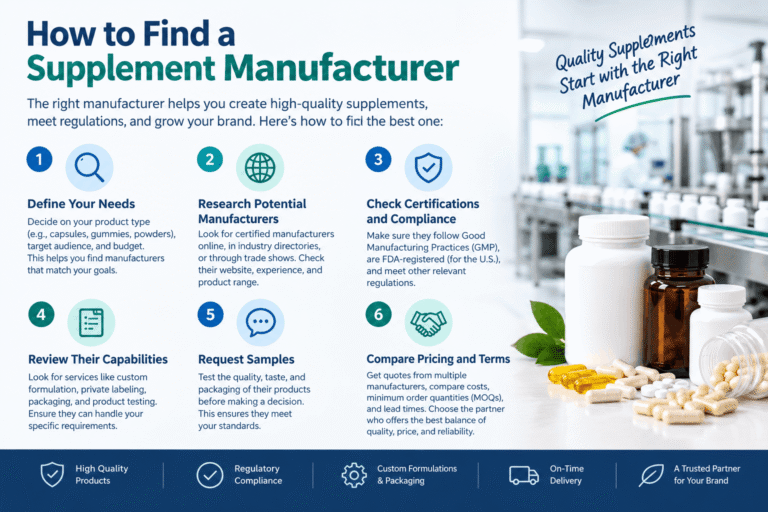
Do not choose on price alone. A very low quote can hide weak quality control, unclear ingredients or hidden costs later. Use this checklist when comparing suppliers.
Certifications you can verify
Look for recognised quality systems such as GMP, HACCP, FSSC 22000 and Halal certification where relevant to your market. Ask for copies of the certificates and check the scope and expiry date. Youdi Nutrition, for example, manufactures in a facility that holds GMP, HACCP, Halal and FSSC 22000 certification, and any serious supplier should be willing to share equivalent documentation.
Batch testing and COAs
Ask whether third-party Certificates of Analysis (COAs) are available for every batch. Testing for identity, potency, heavy metals and microbiological safety protects your customers and your brand.
Samples before production
Never approve a large order without testing a sample. Check taste, texture, colour, dissolution or dosing accuracy, and packaging quality. Free or low-cost sampling is a good sign that a supplier is confident in its work.
Communication and transparency
Are your questions answered clearly and quickly? Does the team explain ingredient sourcing, lead times and limitations honestly? Good communication in the quoting stage usually predicts a smoother production run.
Step 5: Understanding MOQ for New Brands
Minimum order quantity (MOQ) is the smallest batch a factory will produce for one order. It is often the biggest barrier for first-time founders, because large minimums tie up cash and risk unsold inventory.
That is why a low MOQ supplement manufacturer is attractive for startups. Lower minimums let you test your product, collect customer feedback and adjust your formula before investing heavily. When searching for low MOQ private label supplements, keep these points in mind:
• MOQ differs by format, formula complexity and packaging, so always ask for a quote for your specific project.
• Custom formulas and custom packaging usually need higher quantities than stock options.
• Some manufacturers offer shared or combined MOQ programmes, which help smaller brands start with reduced volumes. Youdi Nutrition runs a Shared MOQ programme for this reason.
• A lower MOQ may mean a higher cost per unit, so compare total launch cost, not just unit price.
Step 6: Get Regulations and Labelling Right
Compliance is where many new brands stumble. Rules differ by country, so check the requirements of every market you plan to sell in before finalising your formula and label.
• United States: dietary supplements are regulated under the Dietary Supplement Health and Education Act (DSHEA). Manufacturers must follow FDA current good manufacturing practice rules (21 CFR Part 111), labels need a Supplement Facts panel, and structure/function claims require the standard FDA disclaimer. Foreign food facilities that supply the US market must also register with the FDA, and importers have their own verification duties.
• European Union: food supplements fall under Directive 2002/46/EC, which limits which vitamins and minerals can be used. Health claims must be authorised, and novel ingredients may need separate approval.
• Other markets: the UK, Canada, Australia, the Middle East and South Asia each have their own ingredient lists, labelling rules and import requirements.
Avoid any claim that your supplement diagnoses, treats, cures or prevents disease. We recommend consulting a qualified regulatory advisor for your target market, since rules change over time and this article is general information, not legal advice.
Step 7: Know the OEM/ODM Process and Timeline
Most private label projects follow a similar path:
1. Formula consultation: discuss your goals, target market and ingredients with the manufacturer.
2. Requirements: share your formula or dosage, flavour preferences and packaging needs.
3. Sample production: review a physical sample and request changes.
4. Confirmation: approve the final formula, label artwork and packaging.
5. Production and quality control: the factory manufactures your batch with testing at each stage.
6. Packaging and shipping: finished goods are labelled, packed and shipped by air or sea.
Production for custom products typically takes around 15 to 30 business days depending on formula and packaging complexity, followed by shipping time. Build this into your launch calendar, and leave extra time for sample revisions and customs clearance.
Step 8: Plan Branding, Budget and Launch
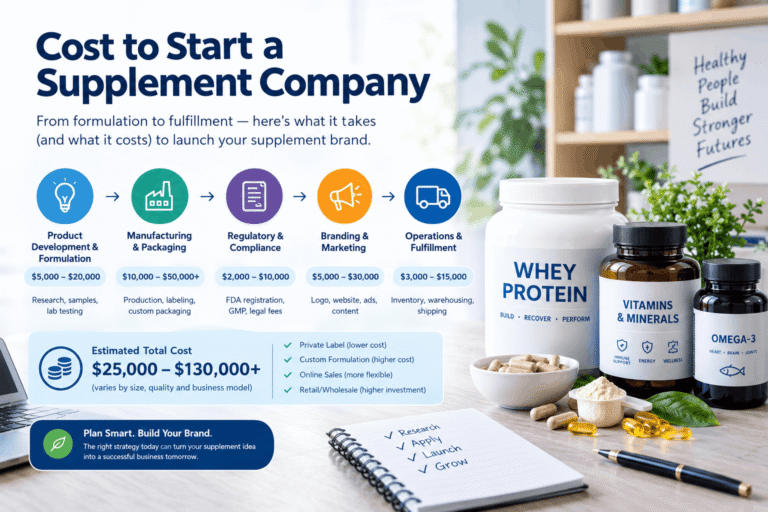
Your manufacturing quote is only one part of your startup budget. Plan for design and packaging, product photography, website and marketplace setup, freight and import duties, insurance and marketing. Many brands underestimate the marketing budget, even though a great product still needs customers to find it.
Start with one or two hero products instead of a full catalogue. Launch, collect reviews, then expand into related formats once you understand what your customers want.
Common Mistakes to Avoid
• Choosing a manufacturer based only on the lowest price.
• Skipping samples or approving them without proper testing.
• Making health claims your ingredients and market rules do not support.
• Ordering too much inventory before validating demand.
• Ignoring shipping time, customs and import rules in the launch plan.
Frequently Asked Questions
How much money do I need to start a supplement brand?
It depends on your format, order size and packaging. Using a low MOQ route and starting with one product can keep your initial investment far lower than launching a full range.
Can I use my own formula with a Chinese manufacturer?
Yes. Many manufacturers offer OEM services for your own formula and ODM services where their team develops one with you. Always have your formula reviewed for compliance in your target market.
Is it safe to buy supplements from China?
It can be, provided you choose a certified manufacturer, request third-party COAs, test samples and verify documentation. The key is due diligence, not the country of origin.
What is the difference between OEM and ODM?
With OEM, the factory produces a product to your specifications. With ODM, the factory supplies or develops the formula, and you brand it as your own.
Conclusion: Build Your Brand on a Reliable Foundation
Learning how to start a supplement brand comes down to a few solid decisions: a clear niche, the right product format, a compliant formula and a manufacturing partner you can trust. A reliable supplement manufacturer in China can give you access to many formats, custom formulation and flexible order sizes, as long as you verify certifications, test samples and understand your target market’s regulations.
If you are ready to turn your idea into a real product, Youdi Nutrition can help. Our team offers free formula consultation, sample production, private label packaging and flexible MOQ options for gummies, capsules, oral liquids, jelly sticks and more, all made in a GMP, HACCP, Halal and FSSC 22000 certified facility. Contact Youdi Nutrition today to discuss your project and request a quote.
4 Responses