If you are thinking about building a supplement company, the first question is almost always the same: how much money do I actually need? The honest answer is that it depends on your product format, your order size, and how much of the work you hand to a manufacturing partner. Some founders launch a first product for under $10,000. Others spend $50,000 or more before the first sale.
This guide walks through every major expense, shows realistic ranges, and explains where new brands tend to overspend. The figures below are planning estimates based on typical industry pricing, not fixed quotes, so always confirm numbers with your own suppliers before you commit.
What Does It Really Cost to Start a Supplement Company?
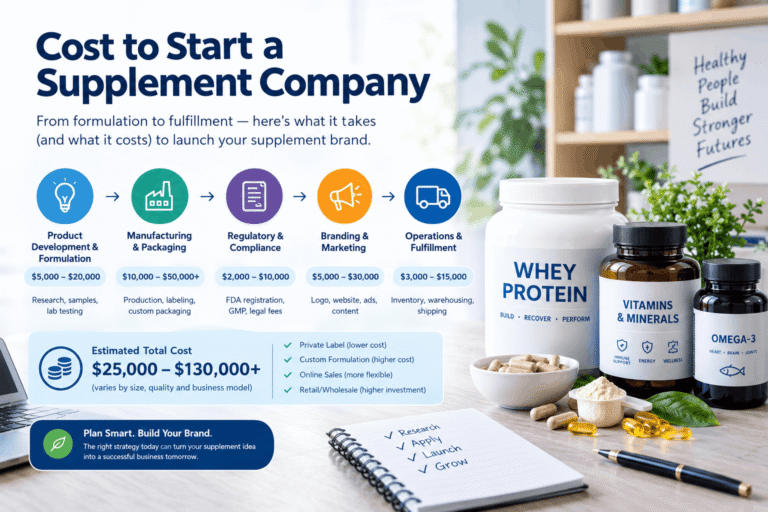
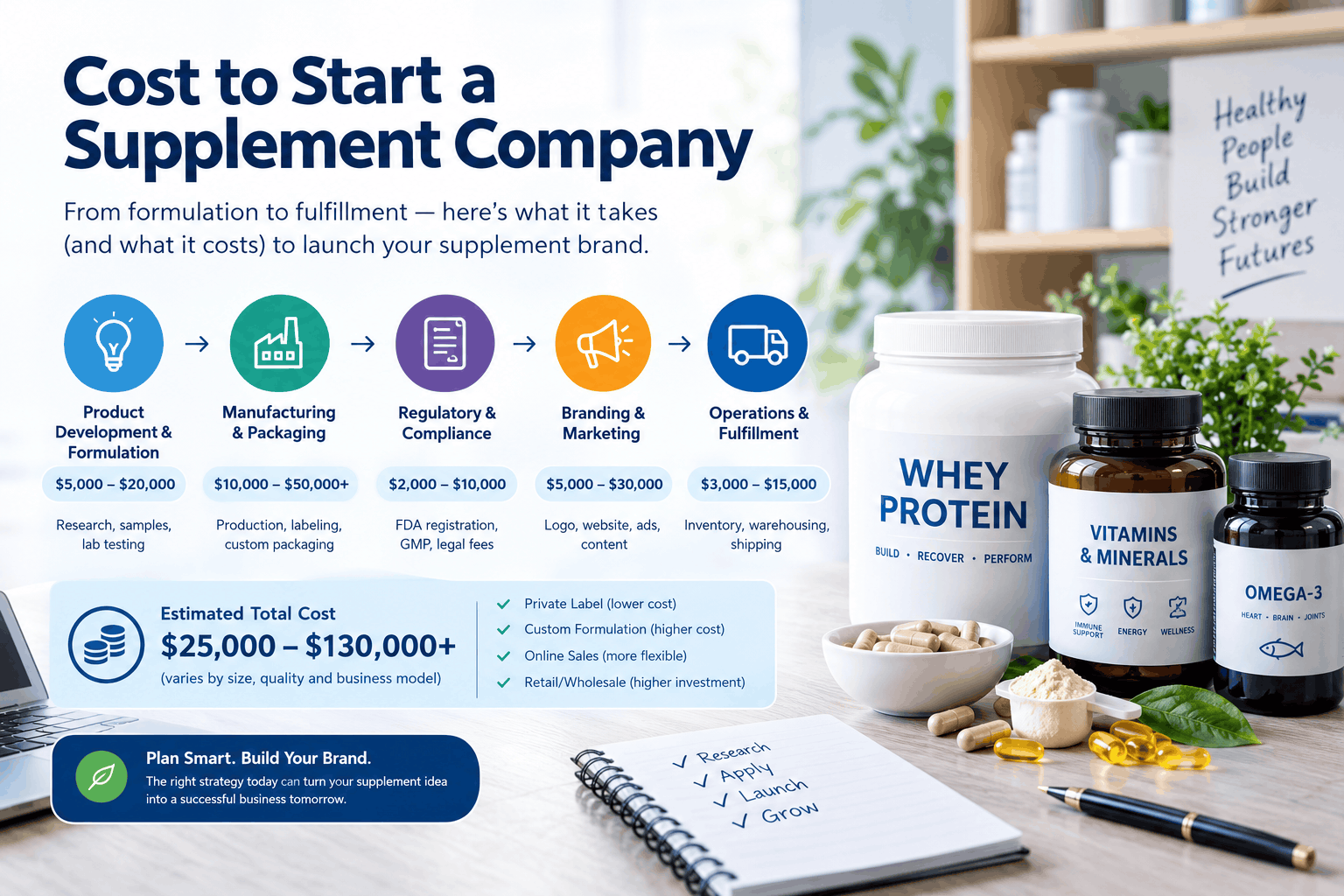
For most first-time founders, a realistic starting budget falls into one of three tiers:
• Lean launch ($5,000 – $15,000): One product, a stock or lightly customized formula, small first batch, and a simple online store. This is the most common route for testing demand.
• Mid-range launch ($15,000 – $30,000): A custom formula or two products, professionally designed packaging, third-party testing, and a real marketing budget.
• Premium launch ($30,000+): A multi-product line, fully custom formulation, larger production runs, brand photography, and paid acquisition from day one.
These tiers are not a quality ranking. A lean launch with a well-chosen product and honest positioning often outperforms a big-budget launch that guessed wrong about the market.
Cost Breakdown: Where Your Money Goes
Here is a line-by-line view of the typical expenses involved when you start your own supplement brand. Totals vary, so treat the ranges as a planning guide.
| Cost Category | Estimated Range (USD) | What It Covers |
| Business setup & legal | $300 – $1,500 | LLC/company registration, EIN, business bank account, licenses |
| Trademark & brand protection | $350 – $1,500 | USPTO filing (around $350 per class in government fees), search, attorney help |
| Product liability insurance | $500 – $3,000 / year | Coverage that most retailers and marketplaces expect |
| Formulation & development | $0 – $5,000 | Stock formulas are often low-cost; custom formulas cost more |
| Samples & revisions | $100 – $600 | Taste, texture and stability checks before you commit |
| First production run | $2,000 – $15,000 | Gummies, capsules or powders at your chosen order quantity |
| Packaging & label design | $500 – $3,000 | Jars, pouches, printed labels, Supplement Facts panel layout |
| Third-party lab testing | $300 – $2,000 | Potency, heavy metals, microbial testing, COAs |
| Website & e-commerce setup | $500 – $3,000 | Store platform, domain, photography, basic copywriting |
| Launch marketing | $1,000 – $10,000+ | Paid ads, influencer samples, email setup, content |
| Shipping & fulfillment | $300 – $2,000 | Inbound freight, storage, packaging materials |
Biggest Cost Drivers, Explained
1. Manufacturing and Minimum Order Quantities
Production is usually your largest single expense, and minimum order quantity (MOQ) is the lever that controls it. Many factories ask for 1,000 units or more per SKU, which ties up thousands of dollars before you know whether customers want the product. Newer, more flexible models exist. For example, Youdi Nutrition offers shared production from 100 units per brand, market-test orders from 200 units, and full custom production from 500 units. Lower entry points like these let you validate a product with real buyers before scaling.
2. Formulation: Stock vs. Custom
If you are researching how to create a supplement, you will quickly meet two paths. A stock (or ready-made) formula is already developed, so your cost is mainly the product itself. A custom formula lets you choose your own actives, dosage, flavor and texture, but development and sampling add time and cost. Beginners often start with a proven base and customize one or two elements, such as flavor or dosage, then move to a fully custom formula once sales justify it.
3. Product Format
Format changes your costs and your customer experience. Capsules and powders are typically simpler to produce. Gummies take more specialized equipment and flavor work, but they are popular because people enjoy taking them daily. If you are comparing a protein gummy manufacturer against other format specialists, ask about formula stability, sugar-free options, and plant-based (pectin) alternatives, since these affect both cost and brand positioning.
4. Regulatory Compliance and Testing
In the United States, dietary supplements are regulated by the FDA under the Dietary Supplement Health and Education Act (DSHEA). Manufacturers must follow current Good Manufacturing Practice (cGMP) requirements under 21 CFR Part 111, and labels must carry a Supplement Facts panel and avoid unapproved disease claims. Registering a food facility with the FDA does not carry a fee, but compliance, label review and testing are real budget items. Do not skip third-party testing. A certificate of analysis (COA) for each batch protects your customers, supports retailer approval, and builds trust.
5. Branding, Packaging and Website
Your packaging does the selling when customers cannot taste or try the product. Budget for label design, a compliant Supplement Facts layout, and clean product photography. A basic Shopify-style store is enough at launch; custom development can wait.
6. Marketing and Customer Acquisition
Many founders underestimate this line. Even a great product needs buyers. Plan for early-stage content, email capture, small paid campaigns, and product seeding to micro-influencers. Marketing is also the most flexible budget item, so you can scale it up as soon as your numbers prove out.
Private Label vs. Building From Scratch
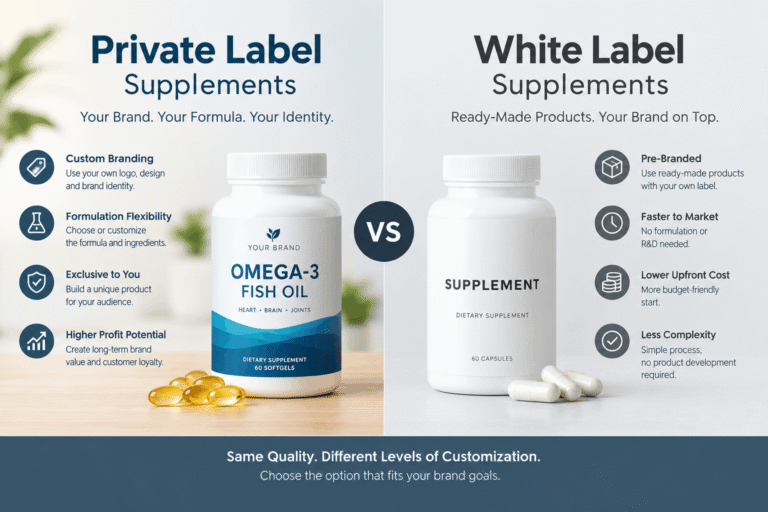
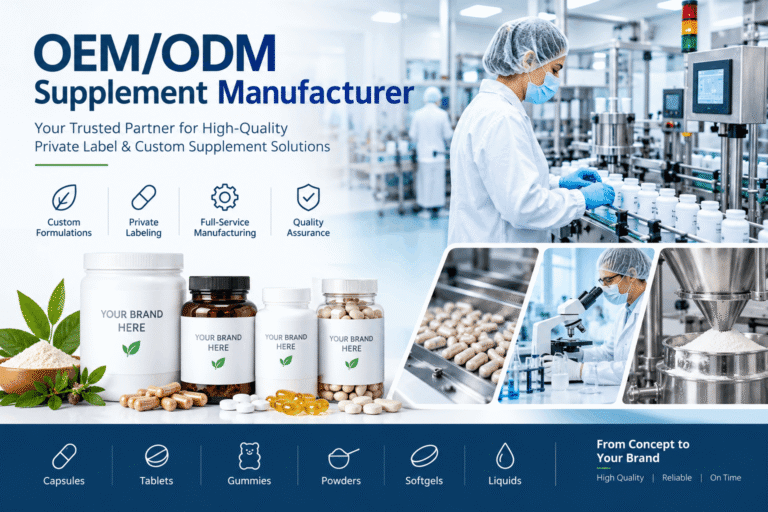
A private label supplement company sells products that a contract manufacturer already knows how to produce, under your brand name and packaging. It is typically the fastest and most affordable way to start, because you skip building a factory, buying equipment, and hiring a quality team. Opening your own manufacturing facility can cost hundreds of thousands of dollars and years of compliance work, which is why nearly all new brands choose a manufacturing partner.
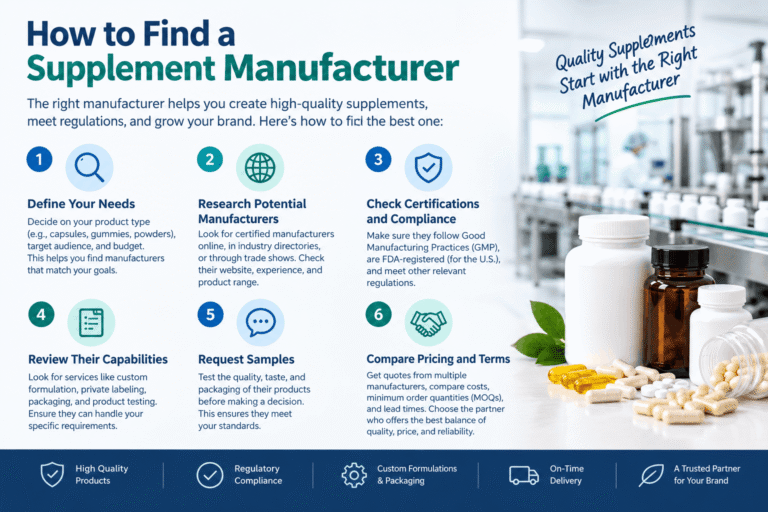
The trade-off is control. With private label you rely on your manufacturer’s quality systems, so choose carefully. Look for these signals:
• Recognized certifications, such as GMP, HACCP, FSSC 22000 and FDA facility registration
• Third-party COAs available for every batch
• Clear traceability from raw materials to finished goods
• Willingness to provide samples before you order
• Flexible MOQs that match a new brand’s cash flow
Youdi Nutrition, for instance, operates a GMP-built facility and lists NSF GMP, HACCP, Halal, FSSC 22000 and FDA registration among its credentials, with samples available for taste and texture checks. Whichever partner you consider, verify certificates directly and request documentation rather than relying on website claims alone.
A Simple Step-by-Step Plan to Keep Costs Under Control
• Validate the idea. Research your niche, competitors and customer reviews before spending on production.
• Register your business. Set up your legal entity, EIN, bank account and insurance.
• Choose your format and manufacturer. Compare quotes, MOQs, certifications and sample policies.
• Order samples. Test taste, texture and appearance, and revise before ordering a full run.
• Start small. Use a market-test or shared production run to reduce inventory risk.
• Protect your brand. File your trademark and secure your domain and social handles.
• Launch, measure, reorder. Track repeat purchases and reviews, then scale the winners.
Common Mistakes That Inflate Your Startup Costs
• Ordering too much too soon. Large first runs lock up cash and risk expired or unsold stock.
• Skipping samples. A flavor or texture problem found after 5,000 units is expensive.
• Ignoring labeling rules. Non-compliant claims can force costly relabeling.
• Launching too many SKUs. One strong product beats five weak ones.
• Forgetting working capital. Keep a reserve for reorders, ads and unexpected delays.
Frequently Asked Questions
Can I start a supplement company with $5,000?
Yes, it is possible with a stock formula, a small or shared production run, simple packaging and a lean marketing plan. It leaves little room for error, so keep your scope to one product.
How long does it take to launch?
Most brands need roughly two to four months from first sample to finished goods, depending on customization, label approvals and shipping times.
Do I need a nutrition degree?
No. Many successful founders partner with experienced formulators and manufacturers. You do need to understand labeling rules and avoid making disease claims.
Is it better to choose gummies, capsules or powders?
Choose the format your target customer will actually use every day. Gummies suit consumers who dislike pills, powders suit performance and greens audiences, and capsules suit precise, high-dose actives.
Conclusion: Start Smart, Scale With Data
The cost to start a supplement company ranges from about $5,000 for a lean launch to $30,000 or more for a premium, multi-product brand. The biggest savings come from choosing a manufacturing partner with flexible order sizes, testing samples before committing, and spending on marketing only when you see real demand. Compliance, testing and honest labeling are not optional extras. They are what turn a first order into a lasting brand.
Ready to start your own supplement brand? Talk to the team at Youdi Nutrition. Share your product idea, target market and budget, and get guidance on formulas, sample options and a launch route that starts from as few as 100 units. Request your free quote today and turn your supplement idea into a real product.