The cost to start a supplement company equals your first production batch plus fixed setup costs: trademark, label and legal review, testing, freight and marketing. No honest single figure exists, because unit price depends on format, formula and quantity. What you control is the order size. At Youdi Nutrition, a first batch starts at 100 units.
This guide is for B2B buyers: Brand founders, distributors and sourcing teams planning to create their own supplement brand. You will get a line-by-line cost stack, a first-year budget template, a quote comparison sheet and the real minimum-order routes of Youdi Nutrition, a GMP, HACCP, FSSC 22000 and halal certified factory in China. We do not publish unit prices, because every project is quoted individually.
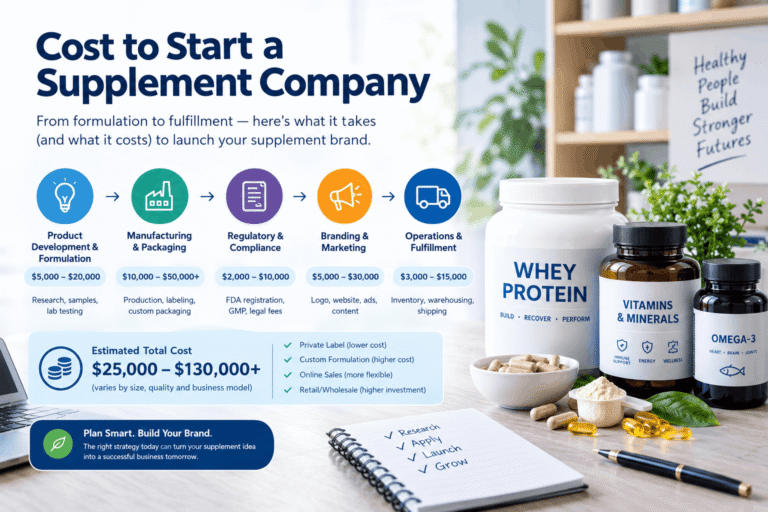
How much does it cost to start a supplement company?
The cost to start a supplement company has two parts. Variable cost covers your first batch, packaging, testing and freight, and it scales with quantity. Fixed cost covers trademark, legal and label review, insurance, website and marketing, and it does not. A factory quotes each project individually, so you build your budget from your own quotes, not from an average.
First-year budget = (units × unit price) + packaging + testing + freight and duties + fixed setup costs + marketing.
Money leaves your account in three stages. Before production you pay for trademark, legal review and label design. At production you pay for the batch, packaging and testing. At launch you pay for freight, duties and marketing. Knowing the order helps you time your cash.
Numbers to know
| Item | Number | Source |
| US trademark base application | $350 per class | USPTO fee changes summary |
| Shared batch minimum | 100 units per brand; the batch runs at 500 combined units | Youdi Nutrition shared MOQ page |
| Market-test order minimum | 200 units | Youdi Nutrition quality page |
| Full custom run minimum | 500 units | Youdi Nutrition quality page |
| Production time | 15 to 30 business days, then freight | Youdi Nutrition product pages |
Treat any published average as a starting question. Your format, market and quantity decide the real number.
What are the costs of a supplements business setup?
A supplements business setup has eight cost lines: first batch, packaging, testing, freight, trademark, legal review, insurance and marketing. The first four scale with quantity. The last four are mostly fixed. Only the trademark line has a published government fee: $350 per class at the USPTO.
| Cost line | Type | What drives it | How to control it |
| First production batch | Variable | Format, formula, quantity | Start with a 100-unit shared batch or 200-unit market test |
| Packaging and labels | Variable | Jar, pouch or bottle; number of flavours | Use standard packaging for the first test |
| Third-party testing | Variable | Number of batches and parameters | Ask for a sample COA before you order |
| Freight and import duties | Variable | Air or sea freight, destination | Quote both modes for your order size |
| Trademark | Fixed | Number of classes, country | File only the classes you sell in |
| Legal and label review | Fixed | Markets and claims on pack | Limit claims to what you can substantiate |
| Insurance and company setup | Fixed | Country and sales channel | Collect quotes before your first sale |
| Website and marketing | Fixed | Channel mix and ambition | Match spend to the size of the first batch |
The USPTO charges a base application fee of $350 per class and does not refund it if the application fails. See the USPTO fee changes summary, and check the live schedule on the day you file.
How much does the first production batch cost?
The first batch costs units multiplied by the quoted unit price, plus packaging. At Youdi Nutrition, unit prices are quoted per project, and the minimum quantity depends on the route: 100 units per brand in a shared batch, 200 units as a market test, or 500 units for full custom production.
| Route | Minimum | Packaging | Cash profile |
| Shared batch | 100 units per brand | Your own approved label | Lowest commitment; the batch runs once combined orders reach 500 units |
| Market-test order | 200 units | Standard packaging | Low; tests demand before custom packaging spend |
| Full custom run | 500 units | Custom formula and packaging | Highest; best for a proven product |
Compare routes by total cash out, not by unit price. A higher unit price at 100 units can cost less in total than a lower unit price at 500 units.
Who this is not for: if you need an exclusive formula from day one, skip the shared batch. See the shared MOQ program for current batches.
How does the product format change the cost?
Format changes cost through ingredients, packaging and process. Gummies need pectin, sweeteners and moulds. Capsules and softgels need shells and fill. Protein gummies add protein content per serving and single-serve pouch printing. Ask every factory to quote the same dose per serving so formats compare fairly.
| Format | Main cost drivers | Product page |
| Gummies | Active dose, sweetener choice (sugar-free options use stevia and monk fruit), shape, packaging | Assorted gummy bears |
| Protein gummies | Protein per serving, single-serve pouch printing | Protein gummy manufacturer |
| Capsules and softgels | Capsule type (softgel, HPMC or gelatin), fill type and size | Capsules and softgels |
| Liquid drops | Dropper bottle, carton, dose | Liquid drops |
| Effervescent tablets | Tube packaging, flavour development | Effervescent tablets |
| Jelly sticks | Single-serve stick film and printing | Jelly sticks |
Dose per serving shifts cost as well. A gummy is less active than a capsule, so a high-dose formula may need more gummies per serving or a different format.
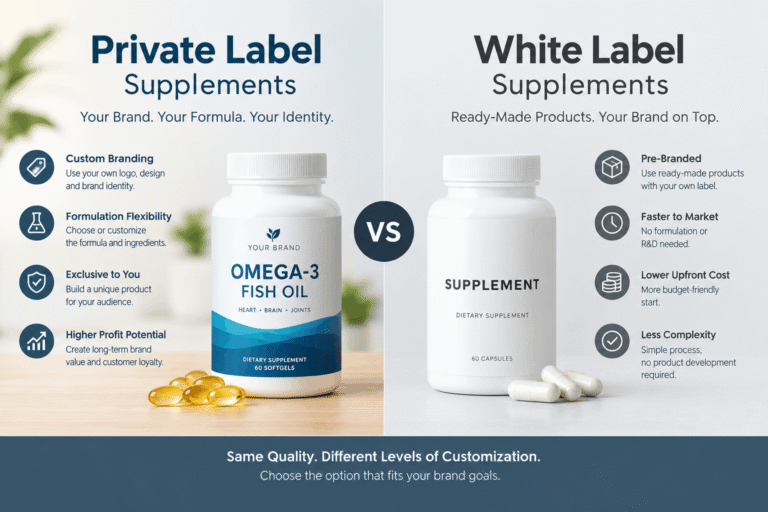
Is a white label supplement cheaper than a private label?
A white label supplement is usually cheaper at launch, because it uses a stock formula that already exists, so you skip development. Private label and OEM add formulation work and give you exclusivity. The best white label supplement manufacturer for a small budget shows a sample COA, a written MOQ and a clear statement on what you may change.
| Model | Formula | Cost profile at launch | Trade-off |
| White label | Stock formula shared with other brands | Lowest: no development cost | Low exclusivity |
| Private label (ODM) | Factory-developed or adjusted for you | Medium: formulation work | Better differentiation |
| OEM | Your own formula | Medium to high: formula transfer and testing | Full control, slowest start |
Suppliers use these terms loosely. Ask in writing whether the formula is sold to other brands and who owns it.
• Pro, fast start: the formula already exists, so sampling begins at once.
• Pro, low development cost: you pay for the product, not for formulation work.
• Con, low exclusivity: other brands can sell the same formula.
• Con, limited changes: changes are usually limited to flavour, colour and label. Confirm per supplier.
How do you create your own supplement brand on a small budget?
Create your own supplement brand in stages. Test one product with a 100-unit shared batch or a 200-unit market test, read the reorder and feedback data, then move to a 500-unit custom run. Each stage spends only what the previous stage justified.
1. Pick one format and one customer. One product costs less to test than a range.
2. Order a free sample. Check taste, texture, colour and packaging fit before you commit.
3. Run the test batch. Use a shared batch or a market-test order.
4. Track reorders and feedback. Decide from sales data, not from opinion.
5. Move to a custom run. Upgrade to custom formula and packaging once demand is proven.
Our one-stop manufacturing service handles formulation, sampling, production, packaging and shipping, so you manage one supplier instead of several. Who this is not for: if a retailer contract requires exclusive packaging or a custom formula from day one, skip the test stage.
How much do private label halal supplements cost?
Halal adds ingredient checks and certificate documentation, not a separate product category. The extra cost depends on how your manufacturer prices ingredient swaps and paperwork. Youdi Nutrition holds a halal certificate from the Halal Development Institute of Indonesia.
• Ingredient swaps: gummies from Youdi Nutrition are pectin-based and gelatin-free, which removes the most common halal problem.
• Certificate scope: confirm the certificate covers your product format and expiry date.
• Market acceptance: confirm your target market recognises the certifier.
1. Ask for two quotes: one with halal documentation and one without.
2. Request the certificate and ingredient-level statements for flavours, colours and shells.
3. Check that every ingredient in your formula is covered by the certificate scope.
Who this is not for: if your market demands a specific national halal mark, confirm that the certifier is recognised there before you set the budget.
What regulatory costs should you budget for?
In the US you pay no FDA approval fee, because the FDA does not approve dietary supplements for safety or effectiveness before they are sold. You still budget for label and claim review, because the company marketing the product must make sure it is safe and that its claims are truthful, per the FDA dietary supplement guidance.
Manufacturing falls under the FDA’s CGMP rule, 21 CFR Part 111. Advertising claims fall under the FTC’s Health Products Compliance Guidance. EU sales follow Directive 2002/46/EC, which permits only listed vitamins and minerals. Ask your manufacturer for its GMP certificate, and see our quality page for the certificates we hold.
Budget one adviser review for each target market. Bring four questions:
Are my ingredients allowed here? Is every claim a structure/function claim and not a disease claim?
Does my label meet local format rules?
Must I notify an authority before sale?
How do you compare quotes from top private label supplement manufacturers?
Compare quotes on one specification: the same dose per serving, fill weight, packaging, MOQ and shipping terms. Then calculate total landed cost for each supplier. Lists of top private label supplement manufacturers rank by reputation or marketing. A comparison sheet ranks by your own numbers. Agree on Incoterms, the standard shipping terms, before you compare freight.
A quote with any of these gaps cannot be compared fairly:
• No MOQ stated.
• No lead time in writing.
• Packaging excluded without saying so.
• No mention of testing or a COA.
• No shipping terms (Incoterms).
How do you build a first-year budget?
Build the budget in three steps: list every cost line, enter your quotes, then add a contingency for reprints and rush freight. A first-year budget covers the first batch, one reorder, fixed setup costs and marketing.
Time the reorder. Order batch 2 while batch 1 is still selling, not after it runs out, because production typically takes 15 to 30 business days before freight.
What hidden costs surprise new supplement brands?
Five costs surprise first-time brands: label reprints after a claim change, rush air freight, extra sample rounds, import duties and unsold stock. Each one has a simple prevention.
• Label reprints: finish claim review before you print.
• Rush air freight: order earlier, because production typically takes 15 to 30 business days before freight.
• Extra sample rounds: send a complete brief in step 2 of the process.
• Import duties: ask a customs broker for your destination before you quote.
• Unsold stock: start with 100 to 200 units and reorder on data.
Budget these as one contingency line, not as five separate guesses.
Frequently asked questions
How much money do I need to start a supplement company?
It depends on format, formula and quantity, so build your budget from quotes. At Youdi Nutrition, a first batch starts at 100 units per brand in a shared batch. Add fixed costs such as a $350 USPTO trademark fee per class, label review, insurance and marketing.
Can I start with a 100-unit order?
Yes, through a shared batch at Youdi Nutrition: 100 units per brand, and the batch runs once combined orders reach 500 units. Each brand uses its own approved label. Confirm which formulas and formats are open in the current batch.
Do I need FDA approval before selling supplements?
No. The FDA does not approve dietary supplements for safety or effectiveness before sale. You must still follow CGMP, labeling and advertising rules, and the company marketing the product remains responsible for safety and truthful claims.
Are supplement samples free?
At Youdi Nutrition, free sample production is step 3 of the OEM process, before you confirm formula and packaging.
Does a halal supplement cost more?
It can, depending on ingredient swaps and certificate documentation. Pectin-based gummies avoid gelatin, a common halal problem. Ask your manufacturer to quote halal and non-halal versions side by side.
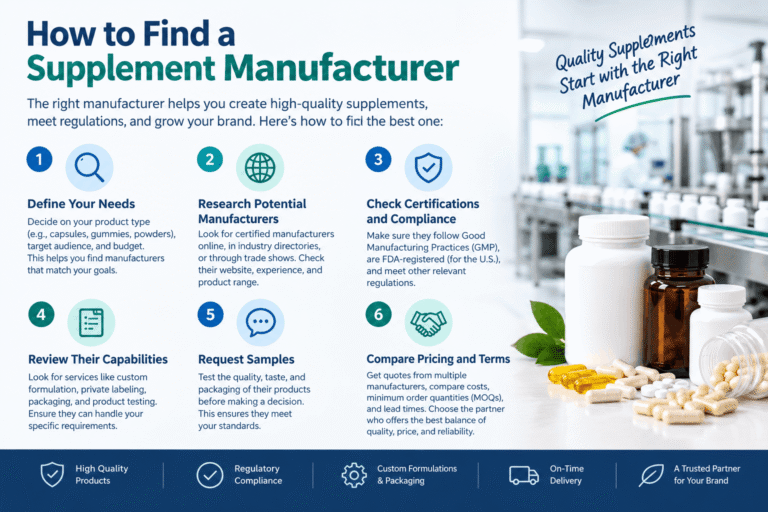
How do I find the right manufacturer on a small budget?
Request the same quote from three manufacturers: same spec, same MOQ, same shipping terms. Compare total landed cost and documents: certificates, a sample COA and formula ownership. A low unit price with no MOQ or COA is a warning sign.
Ready to price your first batch?
To estimate the cost to start a supplement company, send us your format, target market and quantity. Our team returns a written quote and confirms the right MOQ route. Browse our product formats, see how shared MOQ batches work, or contact our team for a free formula consultation. Read the FAQ for sample and quality questions.
Limits of this guide: it covers published fees and our own MOQ routes. It does not quote unit prices. Fees change, so confirm the USPTO schedule on filing day and ask an adviser about local rules.