If you are creating your own supplement brand, the single most important decision you will make is not your logo, your flavor or even your price. It is the factory that turns your idea into a finished product. A strong manufacturing partner protects your customers, your reputation and your margins. A weak one can cost you months of delays, failed batches and, in the worst cases, regulatory trouble.
The good news is that finding the right partner is a process you can learn. This guide walks through exactly how to find a supplement manufacturer, what to check before you sign anything, and which warning signs should send you looking elsewhere. It is written from the perspective of what brand owners, formulators and buyers repeatedly run into when they move from idea to first production run.
Why Your Choice of Manufacturer Matters So Much
Supplements are ingestible products, so quality is not a nice-to-have. In most markets the brand owner is legally responsible for what is sold under its name, even when someone else made it. That means your manufacturer’s ingredient sourcing, testing, cleanliness and documentation become part of your own risk profile.
The right manufacturer also shapes the practical side of your business: how quickly you can launch, how much cash you need upfront, how easily you can add new products later, and whether you can scale without changing suppliers. If you are still at the planning stage, our guide on how to start a supplement business explains where manufacturing fits into the bigger picture.
Step 1: Define What You Want to Make
Before you contact a single factory, get clear on your product. Manufacturers will ask about it in the first conversation, and vague answers lead to vague quotes.
Choose Your Format
The delivery format affects cost, shelf life, minimum order size and how customers perceive your brand. Common options include capsules and softgels, tablets, powders, liquids and gummies. Gummies in particular have become popular because they are easy for customers to take consistently. If that appeals to you, look at what is possible with gummies, protein gummies, filled gummies or custom-shaped gummies formats. Prefer something more traditional? Capsules and softgels, effervescent tablets, jelly sticks and liquid drops are all well-established formats.
Decide on Formulation Approach
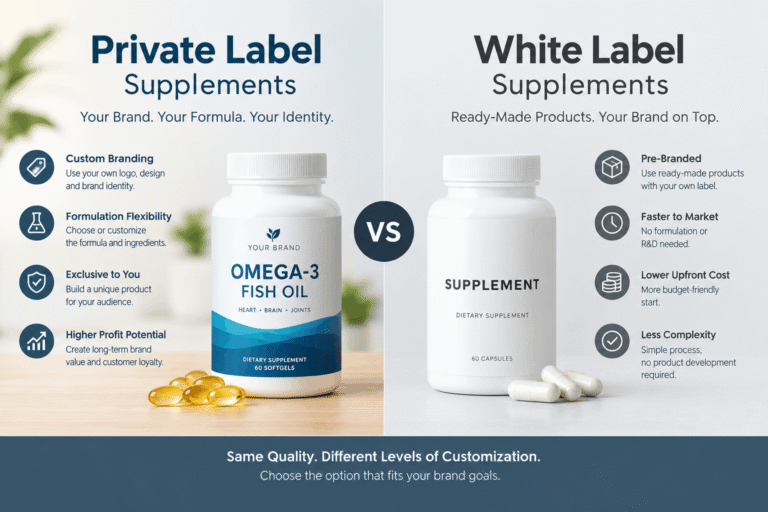
There are two broad routes. With a stock or ready-made formula, you choose from tested formulas and put your own label on them. With a custom formula, the manufacturer develops or adjusts a formula for you. Stock formulas are faster and cheaper. Custom formulas give you something unique but need more time, more testing and usually higher minimums.
Know Your Market and Regulations
Where you plan to sell matters. Requirements for labeling, permitted ingredients, claims and registration differ between the United States, the European Union, the United Kingdom, Australia and other regions. Write down your target countries early so you can ask each manufacturer whether they have experience exporting there.
Understand the Types of Supplement Manufacturers
Not every supplier does the same job, and mixing them up is a common beginner mistake.
• Private label manufacturers offer pre-developed formulas that you brand as your own. This is the fastest route for most new brands and the reason people search for the best private label supplements in the first place.
• Contract (custom) manufacturers produce to your specification and formula. They suit brands with an existing formulation or a clear scientific direction.
• Brokers and trading companies do not own a factory. They place your order elsewhere and add a margin. They are not always bad, but you should know who actually makes your product.
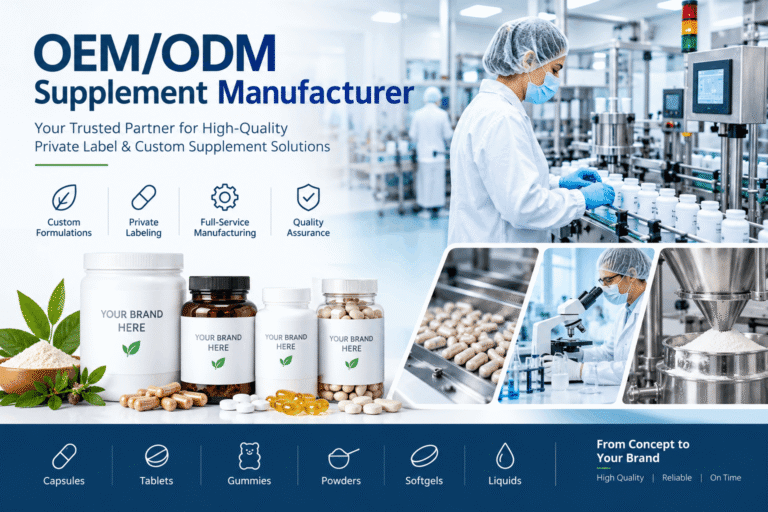
• Full-service partners combine formulation, manufacturing, packaging and sometimes design and fulfillment under one roof.
Step 1: Where to Look for Manufacturers
Start with several channels rather than relying on one.
• Online research. Search for manufacturers in your target format and read their websites carefully. Look for real facility information, certifications and clear product ranges, not only stock photos.
• Comparison guides. Curated lists help you shortlist faster. Our roundup of the best private label supplement manufacturers in 2026 explains what separates strong suppliers from average ones.
• Trade shows and industry events. Meeting teams in person lets you judge professionalism and ask follow-up questions on the spot.
• Referrals. Other brand owners often share honest feedback about reliability, communication and consistency.
Aim for a shortlist of three to five companies. That is enough to compare quotes and responsiveness without becoming overwhelming.
Step 2: Verify Quality Credentials
This is where most of your due diligence should go. A manufacturer that cannot show proof of its standards should not make something people swallow.
• GMP compliance. Ask whether the facility operates under current Good Manufacturing Practice and request supporting documentation or audit reports.
• Registrations and certifications. Depending on your market, relevant items may include FDA facility registration, ISO standards, HACCP, halal or kosher certification, and organic certification.
• Testing. Ask what is tested (identity, potency, heavy metals, microbiology) and whether testing is done in-house or by an accredited third-party lab.
• Certificates of Analysis. A reputable manufacturer provides a batch-specific COA on request.
• Traceability. You should be able to trace each batch back to its raw material lots.
You can see how one manufacturer presents its standards on the Youdi Nutrition quality page, and a good benchmark is whether other suppliers are equally open. To understand how production actually runs, review the manufacturing capabilities information so you know which questions to ask everyone on your shortlist.
Step 3: Compare MOQs, Pricing and Lead Times
Minimum order quantity (MOQ) is often the deciding factor for a new brand. Some factories set high minimums that tie up capital before you have proven demand. Others offer lower or shared minimums designed for startups. Youdi Nutrition explains one approach on its shared MOQ page, which is worth reading even if you are comparing it with other suppliers.
When you compare quotes, make sure you are comparing like with like:
• Is the price per unit inclusive of packaging, labels and testing?
• What are the one-off costs, such as molds, plates, artwork setup or formulation fees?
• What is the realistic lead time from approval to shipment, and what happens if it slips?
• What are the payment terms and who handles shipping?
Step 4: Request Samples and Ask Smart Questions
Never commit to a full production run without samples. Check taste, texture, color, disintegration or dissolving, packaging quality and label accuracy. Then ask direct questions that show whether the team knows its craft:
• How do you handle a batch that fails testing?
• Who owns the formula and the artwork files?
• Can I visit the facility or join a video audit?
• What support do you offer with labels and compliance claims?
Pay attention to how quickly and clearly they respond. The way a company communicates during the sales process is usually the best preview of how it will communicate when something goes wrong.
Quick Comparison: What to Check and What Good Looks Like
| Area | What to check | What good looks like |
| Quality systems | GMP, audits, testing | Documents shared openly, batch COAs on request |
| Product range | Formats and formulas | Clear catalogue with sample options |
| MOQ | Minimums and flexibility | Realistic for your stage, stated upfront |
| Communication | Response time and clarity | Specific answers, named contact person |
| Transparency | Facility and ownership | Open about who manufactures your product |
Red Flags to Watch For
• No clear information about the factory or its certifications.
• Pressure to pay a large deposit before samples or documentation.
• Unrealistic health claims or promises of guaranteed sales.
• Unwillingness to share testing documents or answer technical questions.
• Prices far below every other quote, which often signals shortcuts in ingredients or testing.
What the Best Private Label Manufacturers Have in Common
When people search for the best private label supplement manufacturers, they usually want a name. A more useful approach is to understand the traits. The strongest partners tend to combine documented quality systems, a broad product range, flexible order sizes, transparent communication and genuine support after the first order. Reading the about page of any company you are considering will tell you a lot about its experience, team and approach.
Remember too that the best manufacturer for someone else may not be the best for you. A gummy-focused brand needs different strengths than a sports-nutrition powder brand. Match the manufacturer to your product, your budget and your growth plans.
Beyond the Factory: Supplements Business Setup Essentials
Finding a manufacturer is one part of your supplements business setup. While you vet suppliers, plan the rest in parallel:
• Register your business and check the rules for selling supplements in your market.
• Develop your brand identity, packaging and label content, and review claims carefully.
• Plan sales channels such as your own website, marketplaces or retail partners.
• Check product liability insurance requirements.
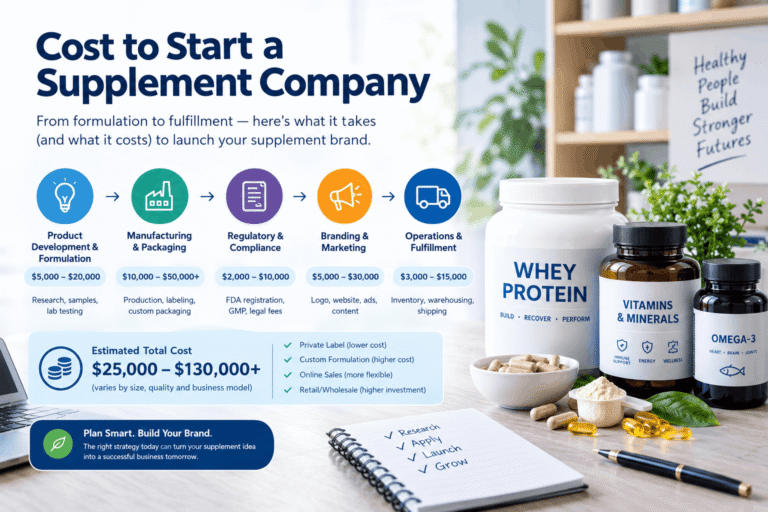
• Build a launch budget that includes marketing, not just production.
For a deeper walk-through of naming, positioning and launch planning, read our guide to how to start a supplement brand. You can also browse more articles on the blog as you plan each stage.
Frequently Asked Questions
How long does it take to find and onboard a supplement manufacturer?
Research and shortlisting often takes a few weeks. Sampling, formula approval and artwork can add several more weeks depending on format and complexity. Allowing a few months from first inquiry to first delivery is a realistic expectation for most new brands.
Do I need my own formula?
No. Many successful brands launch with proven ready-made formulas and customize over time as they learn what their customers want.
Can I start with a small order?
Often yes, but it depends on the manufacturer and format. Ask about flexible or shared minimums, and check the FAQ pages of suppliers for ordering details.
Conclusion: Choose a Partner, Not Just a Price
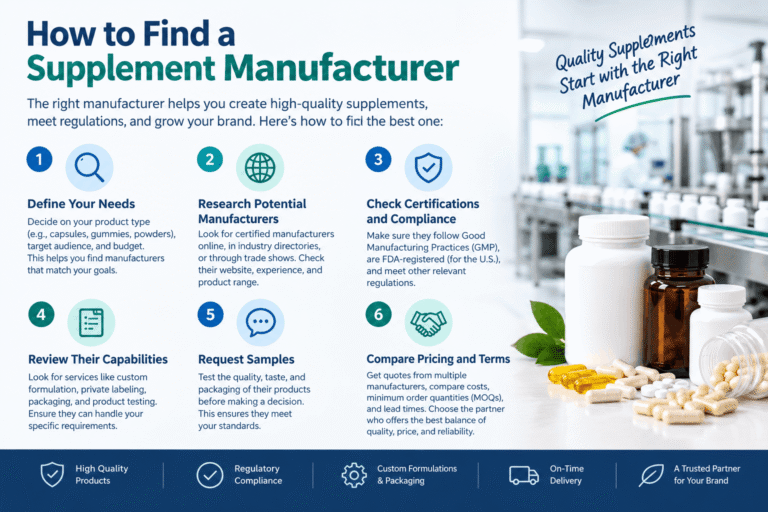
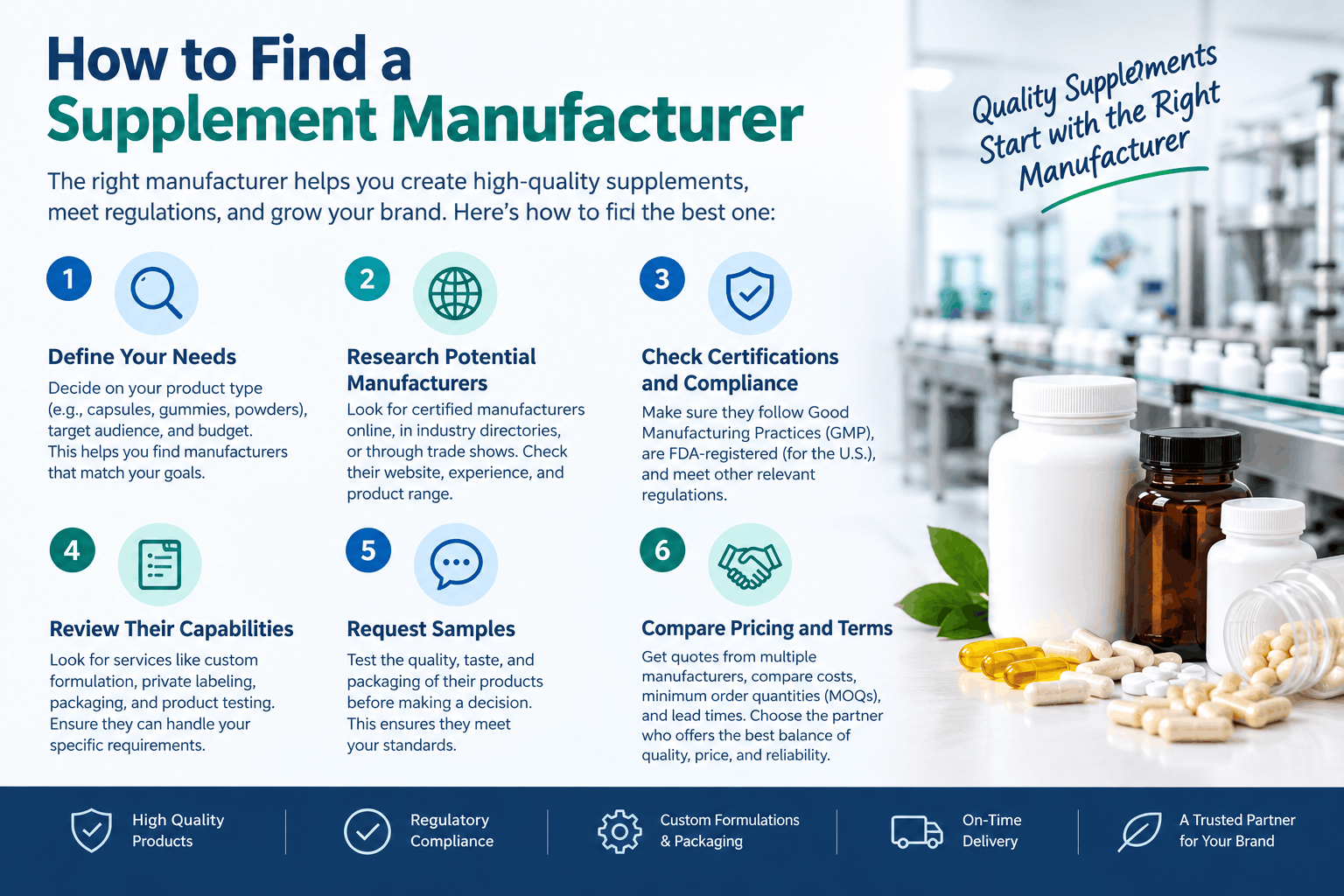
Learning how to find a supplement manufacturer comes down to a clear sequence: define your product, understand the types of suppliers, build a shortlist, verify quality credentials, compare MOQs and pricing, test samples and watch for red flags. Take your time with each step, because the choices you make now will follow your brand for years.
If you are ready to move from research to action, Youdi Nutrition can help you explore formats, formulas and order options that fit your stage. Browse the full product range, then contact our team to discuss your idea, request samples and get a quote for your first run. Your brand deserves a manufacturing partner you can trust. Start the conversation today.