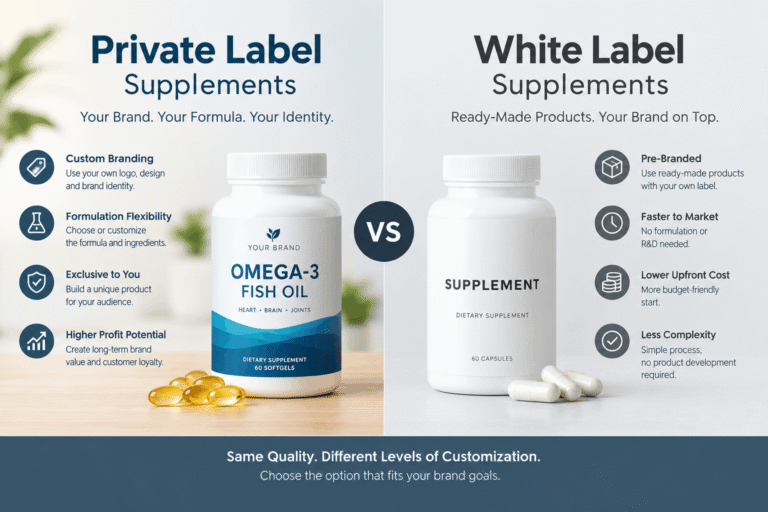
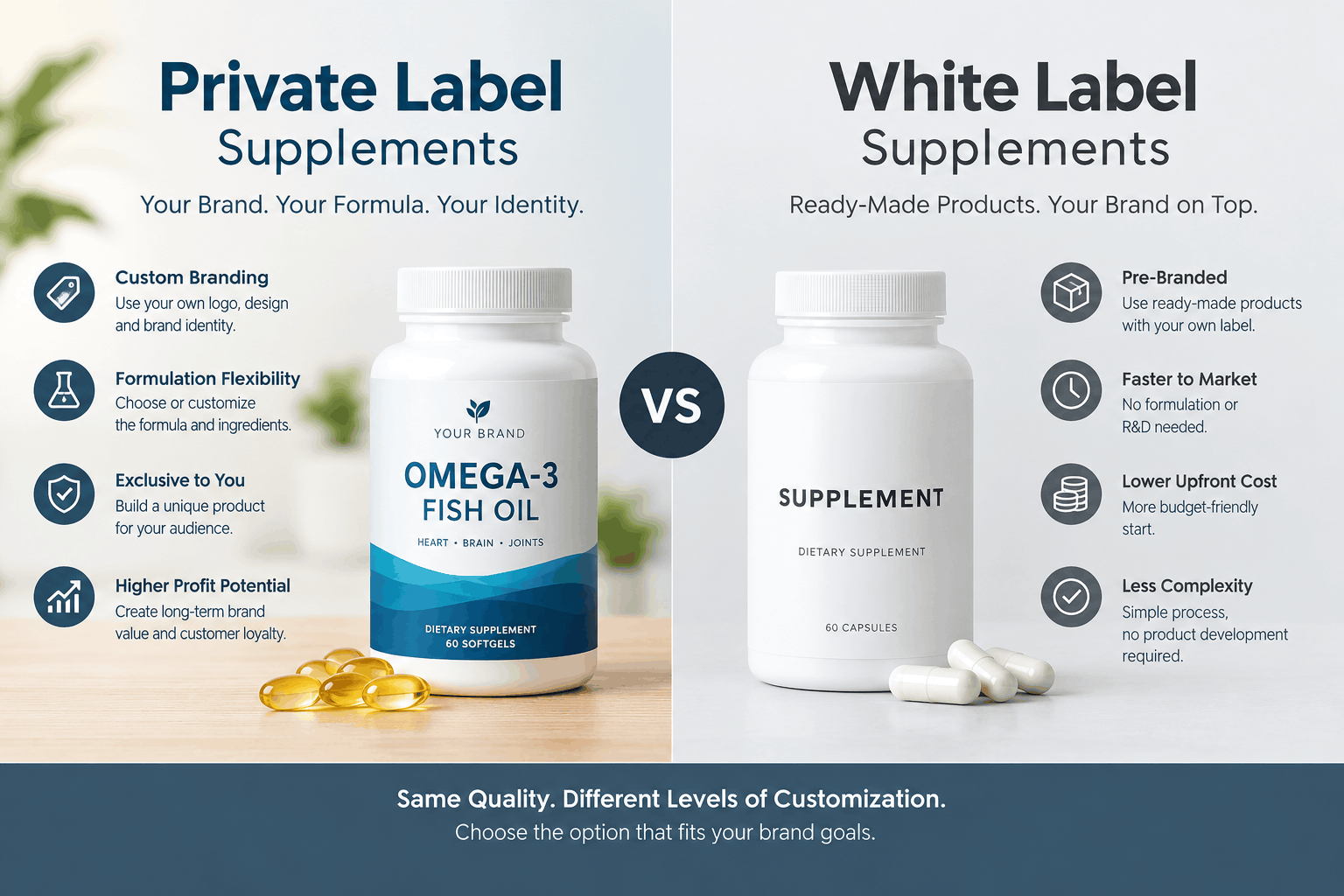
Private label vs white label supplements comes down to one question, who controls the formula? With private label, a contract manufacturer creates or adjusts a formula for your brand. With white label, the manufacturer sells you a stock formula that other brands can sell too, and you add your own label.
This guide is for founders, distributors and sourcing teams choosing a manufacturing model. By the end you will know how the two models differ in cost, speed, exclusivity and compliance, and you will have a simple rule for choosing. We wrote it from the manufacturer’s side at Youdi Nutrition, a GMP, HACCP, FSSC 22000 and halal certified supplement factory in China.
What are private label supplements?
Private label supplements are products made by a contract manufacturer and sold under your brand, with a formula created or adjusted for you. You decide the dose, flavour, format and packaging. The factory supports formulation, production, testing and shipping.
Private label sits on a spectrum. At one end, the factory develops the formula for you. At the other end, you bring your own formula and the factory produces it. In both cases the formula is built around your brand, not pulled from a shelf. That is why private label suits brands that want a claim, a flavour or a dose that competitors do not have.
What are white label supplements?
White label supplements are ready-made products that a manufacturer already sells to two or more brands. You pick a stock formula, add your label and packaging, and sell it under your name. The formula inside is the one other buyers may also use.
White label removes the slowest steps: formula development and repeated sampling. Changes are usually limited to flavour, colour and label design, and each supplier sets its own limits. The trade-off is exclusivity. If another brand buys the same formula, your product and theirs match inside the pack.
Private label vs white label supplements: what are the key differences?
The main differences are formula ownership, exclusivity, customisation, speed and cost at launch. White label is faster and cheaper to start. Private label costs more to start but gives you a formula that is yours. Here is the side-by-side view.
| Factor | White label | Private label |
| Formula | Stock formula the manufacturer already sells | Made or adjusted for your brand |
| Exclusivity | Low: other brands can sell the same formula | High when agreed in writing |
| Customisation | Label, flavour, colour and packaging options | Dose, ingredients, flavour, shape and packaging |
| Speed to first order | Fastest | Slower: formulation and sample rounds |
| Cost at launch | Lower: no development work | Higher: formulation work and testing |
| Best for | Fast market tests and small budgets | Differentiated brands with a clear claim |
| Main risk | Your product looks like competitors’ products | Higher up-front investment |
Where do OEM and ODM fit in?
OEM and ODM describe who supplies the formula. Under OEM, you bring the formula or specification and the factory makes it. Under ODM, the factory develops or supplies the formula and you sell it under your brand. Private label usually covers both, and white label usually matches ODM with a stock formula.
Suppliers use these four terms loosely. Before you sign, ask three questions in writing: Is this formula sold to other brands? Who owns it? Can I move it to another factory?
What are the pros and cons of each model?
Private label: pros and cons
- Pro, exclusive formula: competitors cannot buy the same product.
- Pro, control: you set the dose, flavour, shape and packaging.
- Pro, differentiation: a formula built around one clear claim stands out on the shelf.
- Con, higher launch cost: formulation work and sample rounds add expense.
- Con, longer timeline: development comes before production.
- Con, larger minimums: at Youdi Nutrition, a full custom run starts at 500 units, against 100 units for a shared batch.
White label: pros and cons
- Pro, fast start: the formula already exists, so sampling begins at once.
- Pro, low development cost: you pay for the product, not for formulation work.
- Pro, small starting quantities: a shared batch at Youdi Nutrition starts at 100 units per brand.
- Con, low exclusivity: other brands can sell the same formula.
- Con, limited changes: you adjust flavour, colour and label, not the formula.
- Con, harder to stand out: your product can match competitors’ products.
How do minimum orders and costs differ in practice?
In the private label vs white label supplements decision, white label usually needs the smallest first order, and private label needs the larger one. At Youdi Nutrition, a shared batch starts at 100 units per brand and runs once combined orders reach 500 units. A market-test order starts at 200 units. A full custom run starts at 500 units.
| Route | Minimum | Closest model | Packaging |
| Shared batch | 100 units per brand | White label | Your own approved label |
| Market-test order | 200 units | Test stage for either model | Standard packaging |
| Full custom run | 500 units | Private label or OEM | Custom formula and packaging |
In a shared batch, two or more brands order the same production run and each brand uses its own approved label. That is why a shared batch works much like white label.
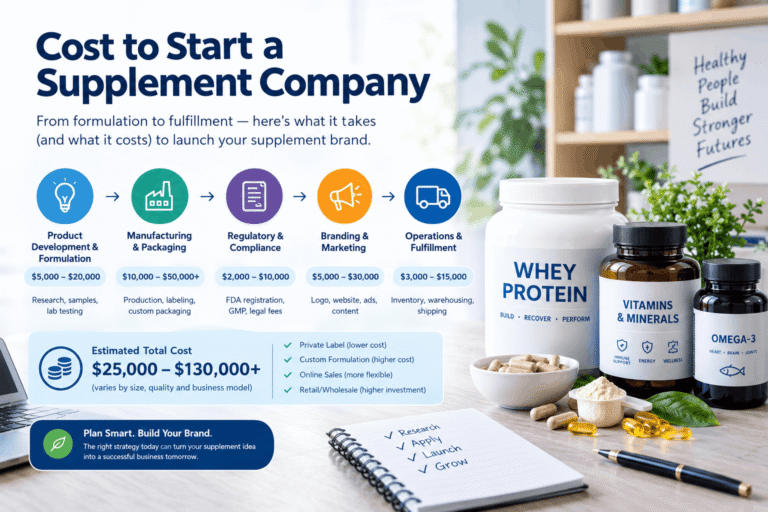
Compare cost by total cash out, not by unit price. A higher unit price at a small quantity can cost less in total than a lower unit price at a larger quantity. Unit prices depend on format, formula and quantity, so request written quotes for your own project.
Which model should you choose?
Choose white label if you want to test demand fast on a small budget. Choose private label if you have a proven product and need a formula that is yours. Choose OEM if you already own a formula. The table below matches common situations to a model.
| Your situation | Better fit | Why |
| Testing one product on a small budget | White label (shared batch) | Lowest cash commitment and the fastest start |
| Selling a proven product and wanting to stand out | Private label | The formula and the claim belong to you |
| You already own a formula | OEM | The factory produces your specification |
| Entering a market with strict ingredient rules | Private label | You can adjust the formula to the ingredients that market allows |
Who this is not for: if you need an exclusive formula from day one, skip white label. If you only want to test demand cheaply, skip custom formulation for now. A staged path also works: test with white label or a shared batch, then move products that sell to a private label formula.
What legal and quality rules apply to both models?
Both models leave the legal responsibility with you as the brand owner. In the US, the FDA does not approve dietary supplements for safety or effectiveness before they are sold. Under the Dietary Supplement Health and Education Act of 1994 (DSHEA), the company marketing the product must make sure it is safe and that its label claims are truthful.
Manufacturing must follow current good manufacturing practice (CGMP) under 21 CFR Part 111, which covers manufacturing, packaging, labeling and holding of dietary supplements. The Federal Trade Commission (FTC) requires advertising claims to be substantiated, and its Health Products Compliance Guidance explains how. In the EU, food supplements fall under Directive 2002/46/EC, which permits only listed vitamins and minerals in listed forms.
That last rule matters for white label. A stock formula built for one market may contain an ingredient form that another market does not allow, so check the ingredients before you order. This article is general information, not legal advice.
How do you choose a manufacturer for either model?
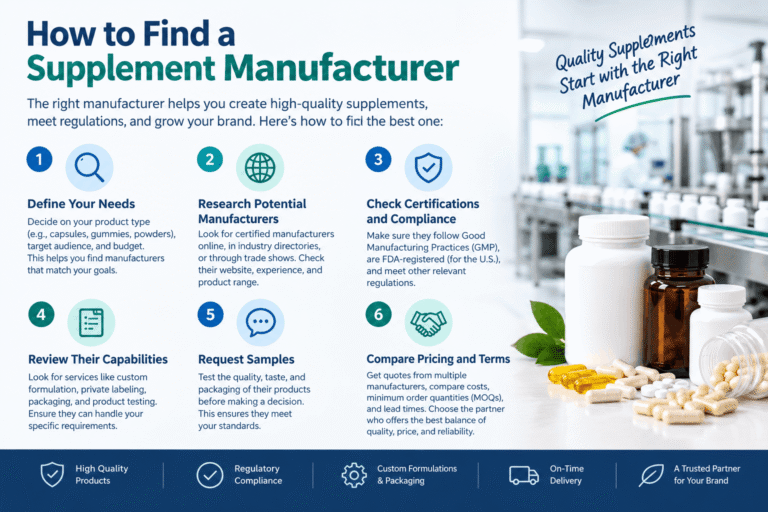
Choose a manufacturer by documents, not websites. Ask for current certificates with scope and expiry dates, a sample third-party certificate of analysis (COA), a written MOQ and lead time, and a written statement on formula ownership. A supplier that cannot show these within a few days is a risk for your first batch.
- A GMP certificate that names the issuing body, the scope and the expiry date.
- Food safety certificates such as HACCP and FSSC 22000.
- A sample COA with a batch number and test results.
- A halal certificate if you sell to halal markets.
- A written quote that lists MOQ, lead time and sample policy.
- A written statement on who owns the formula.
As a reference, Youdi Nutrition lists an NSF/ANSI 455-2 GMP certificate for dietary supplements, HACCP, FSSC 22000, a halal certificate from the Halal Development Institute of Indonesia, and a US FDA food facility registration. Facility registration is not FDA approval of the factory or its products. Third-party COAs are available for every batch, free sample production is step 3 of our OEM process, and production typically takes 15 to 30 business days before air or sea freight.
What mistakes should you avoid?
- Assuming the terms mean the same thing everywhere. Confirm what the supplier means by private label and white label.
- Skipping the formula ownership question. Without a written answer, you may be unable to move production later.
- Choosing on unit price alone. Compare total cash out for your quantity.
- Ignoring destination rules. A formula that is legal in one market may be restricted in another.
- Treating FDA registration as approval. It is not.
Frequently asked questions
Is white label cheaper than private label?
Usually at launch, because the formula already exists and you skip development. Private label adds formulation and testing. Compare total cost for your own quantity, not only the unit price, and ask for written quotes.
Can I start with white label and switch to private label later?
Yes. You can test demand with white label, then commission a custom formula for products that sell. Keep your sales data and flavour feedback to guide the new formula, and ask your supplier whether your current formula stays exclusive to you.
Do I need FDA approval for either model?
No. The FDA does not approve dietary supplements for safety or effectiveness before sale. You must follow CGMP, labeling and advertising rules, and you remain responsible for safety and truthful claims in both models.
Who owns the formula in a private label deal?
It depends on the contract. Ask for a written statement of ownership and whether you can move production to another factory. Without that statement, you may be unable to change suppliers later.
What is the difference between OEM and private label?
OEM describes who supplies the formula: you bring it and the factory makes it. Private label describes how the product is sold: under your brand. An OEM project is usually private label, but private label can also use a formula the factory develops (ODM).
What is the minimum order for each model at Youdi Nutrition?
A shared batch starts at 100 units per brand and runs once combined orders reach 500 units. A market-test order starts at 200 units. A full custom run starts at 500 units. Request a written quote for exact pricing.
Conclusion: Choose the Model that Matches Your Stage
The choice between private label vs white label supplements is a trade-off between speed and ownership. White label gives you speed, small quantities and a low start-up cost, but your formula is not exclusive. Private label gives you a formula that belongs to your brand, but it costs more and takes longer. Neither model removes your responsibility for safe products and truthful claims. Ask for written answers on formula ownership, MOQ and certificates, and compare total cost, not unit price.
Ready to decide? Tell Youdi Nutrition your format, target market and quantity. Our team will recommend a white label shared batch or a private label formula, confirm the MOQ route and send a written quote. Start your project today and request a free formula consultation on WhatsApp at +86 176 3394 7084.